Foundational Law 03 of GTM Architecture
Functional Activity Without Coherence Is Structural Dilution

Executive Summary
The most dangerous GTM failure mode does not look like failure.
Marketing is active. Sales is running pipeline. Product is shipping. Customer Success is onboarding. Every function reports progress. Every dashboard shows movement.
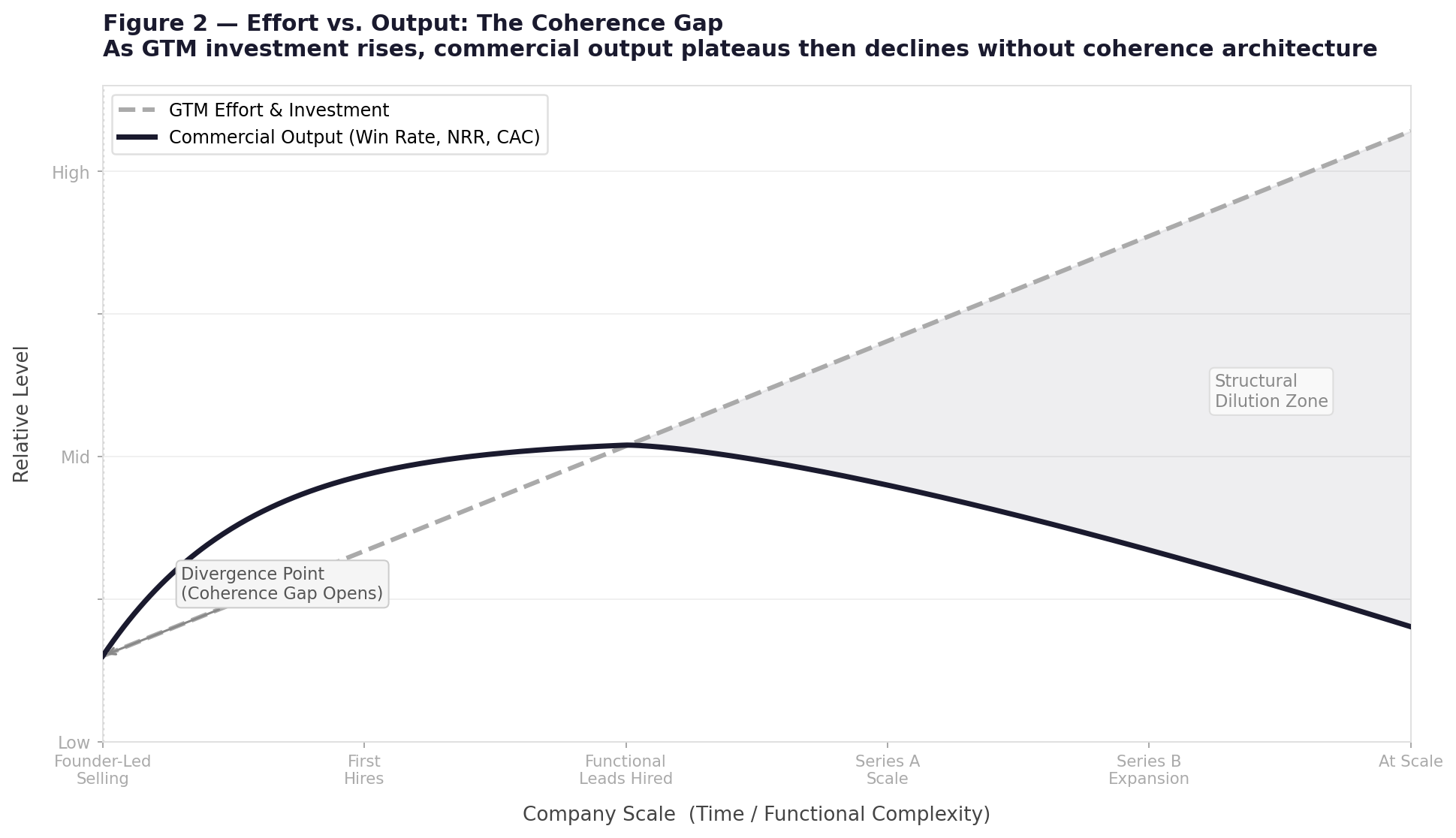
But revenue is not compounding the way effort should produce. Win rates are softening without a clear cause. Customer acquisition cost is rising. Net revenue retention is declining. The organization is working measurably harder for incrementally less output.
This is not a talent problem. It is not a demand generation problem, though demand generation will absorb the blame. It is not a sales execution problem, though new training programs will be commissioned in response.
It is a coherence problem. And coherence is an architectural property, not a cultural one.
This law establishes five structural truths:
Functional activity without system coherence produces dilution, not compounding.
Coordination is not coherence. Functions can be synchronized and still misaligned at the system level.
GTM coherence fails predictably at four structural points as organizations scale.
Revenue stalls not because effort declines but because the system no longer matches how buyers evaluate, decide, and purchase.
Coherence cannot be restored through culture programs or communication improvements. It requires architectural intervention.
Organizations that treat coherence as architecture build systems where each function amplifies the others. Organizations that treat coherence as culture watch their functions gradually optimize in isolation until the system produces structural drag faster than any individual function can compensate for.
The Structural Failure Pattern
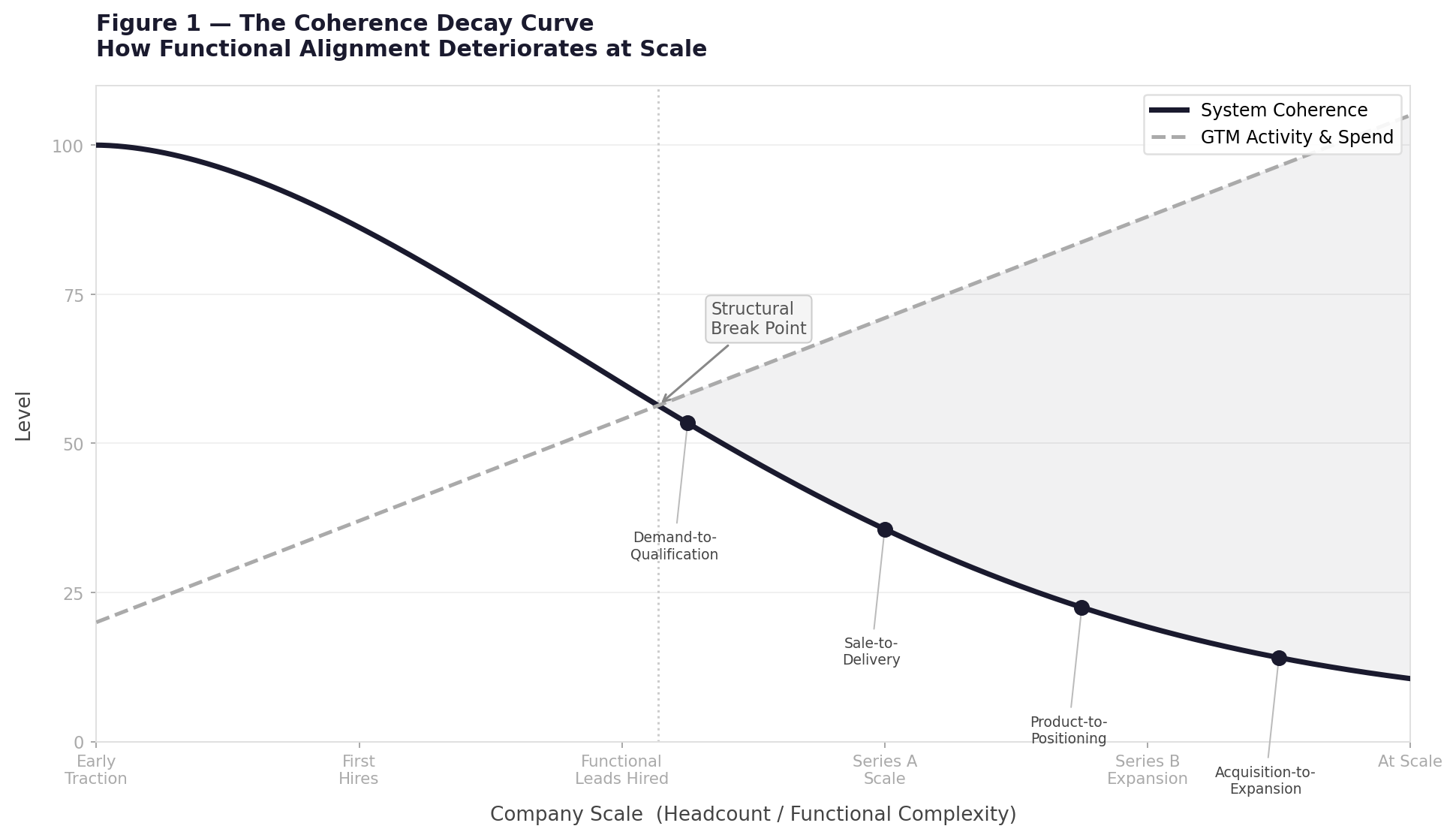
A recognizable pattern repeats itself at a specific stage of company growth.
The company has passed early traction. Revenue is real. The team has expanded beyond founder-led selling. Functional leaders have been hired to own their domains. Each function now operates with increasing sophistication and, critically, increasing independence.
Marketing optimizes for MQL volume. Sales optimizes for close rate. Product optimizes for the feature requests generating the most noise. Customer Success optimizes for renewal and NPS. Each function performs against its own definition of success. Each leader presents a credible case for strong execution.
And yet the system’s output per dollar of input is declining.
The positioning Marketing uses to generate demand no longer reflects the language Sales uses to qualify and close. The ICP Sales is closing no longer matches the customer profile Product is building for. The value promised at the point of sale no longer reflects the experience Customer Success is delivering. Each function has drifted from a shared architectural center that, upon examination, was never formally established in the first place.
The system is not broken. It is incoherent. The distinction is structural and it determines whether the intervention that follows will be tactical or architectural.
The Structural Principle
Revenue stalls when the system no longer matches how buyers evaluate, decide, and purchase.
This is the foundational coherence law. It is not a metaphor. It is a structural description of what happens when the internal logic of a GTM system diverges from the external logic of the buying process.
When Marketing’s demand narrative reflects a problem frame the buyer no longer prioritizes, pipeline volume becomes a vanity metric.
When Sales qualification logic admits opportunities that Product cannot serve at the promised standard, expansion economics deteriorate before the ink is dry on the contract.
When Customer Success inherits expectations set by a sales motion the buyer experienced differently than intended, net revenue retention becomes a lagging indicator of a coherence failure that occurred months earlier at the point of sale.
Each of these failures looks like a functional execution problem. Each is a coherence gap between what one function produces and what the next function requires.
Coherence is the structural condition in which each function’s output is precisely the input the next function needs to produce its best result. When coherence is present, effort compounds. When coherence is absent, effort cancels.
Coordination Is Not Coherence
The most common misdiagnosis of this problem is to treat it as a coordination failure.
The organization schedules more cross-functional meetings. A revenue operations function is created to manage handoffs. A shared dashboard is built so every team can see the same pipeline data. These interventions address the visible symptom: that functions are not communicating frequently or transparently enough.
The actual problem is upstream of communication. It is a problem of architectural definition.
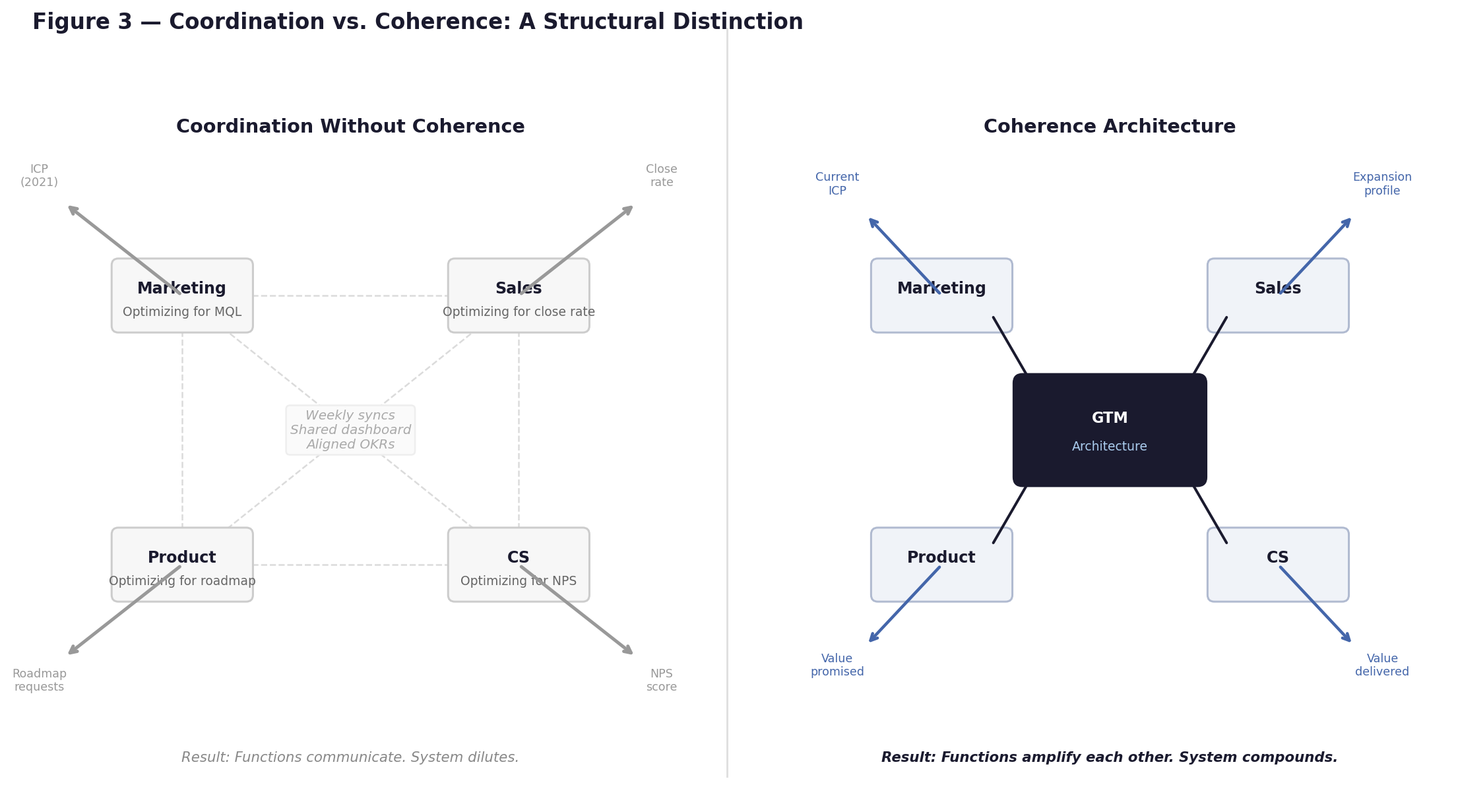
Coordination governs how functions communicate. Coherence governs what they are optimizing toward.
Two functions can have perfect coordination, weekly syncs, shared CRM visibility, and aligned OKRs, and still produce dilution at their intersection if they are operating from different assumptions about who the product is for, what problem it solves, how value is realized, and what a successful customer looks like twelve months post-close.
Coherence requires that these assumptions be formally defined, consistently embedded across every function, and maintained as a living architectural document that updates when market reality changes, not as a strategy slide reviewed annually and interpreted differently by every team in between.
The Four Coherence Failure Points
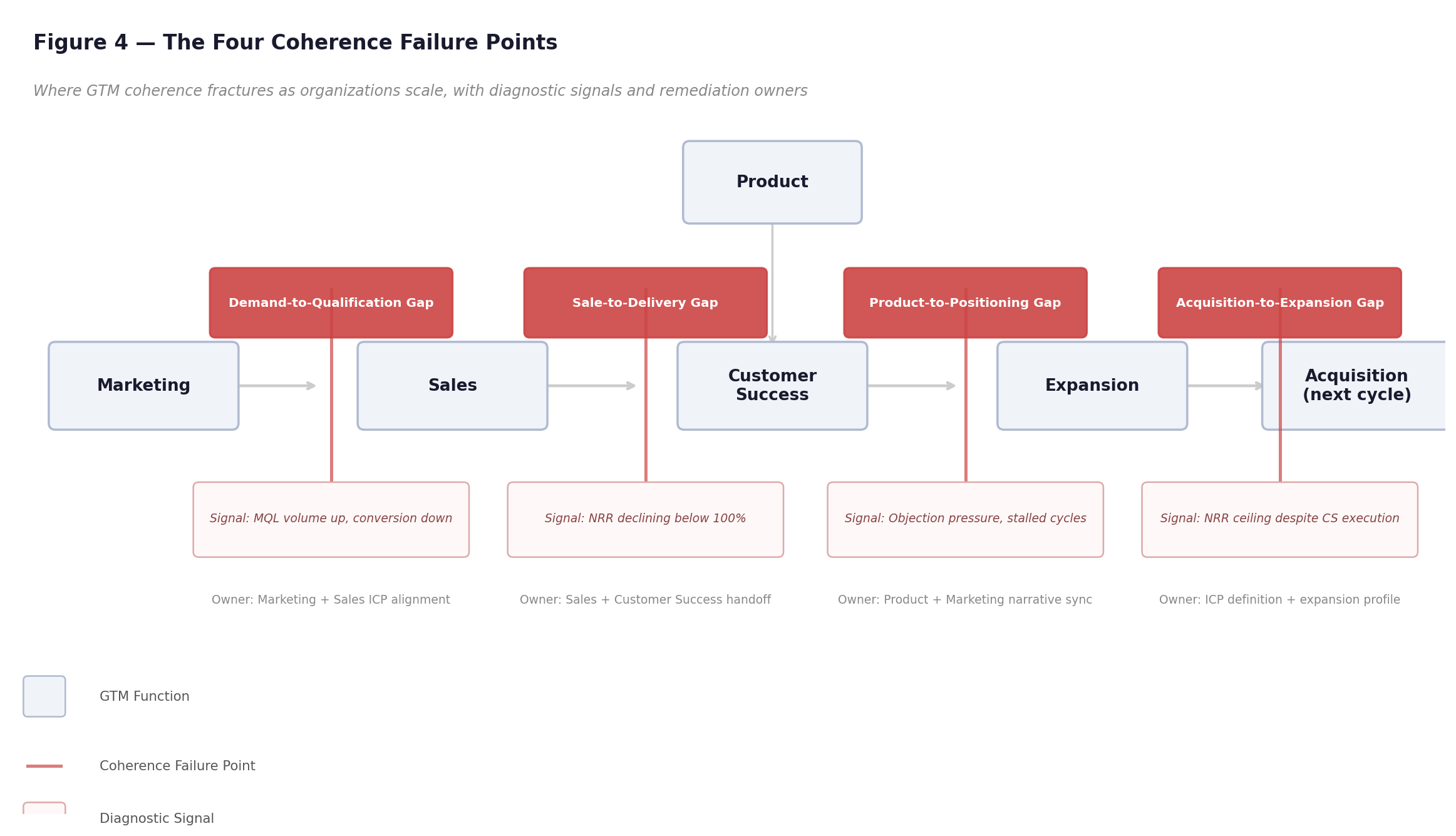
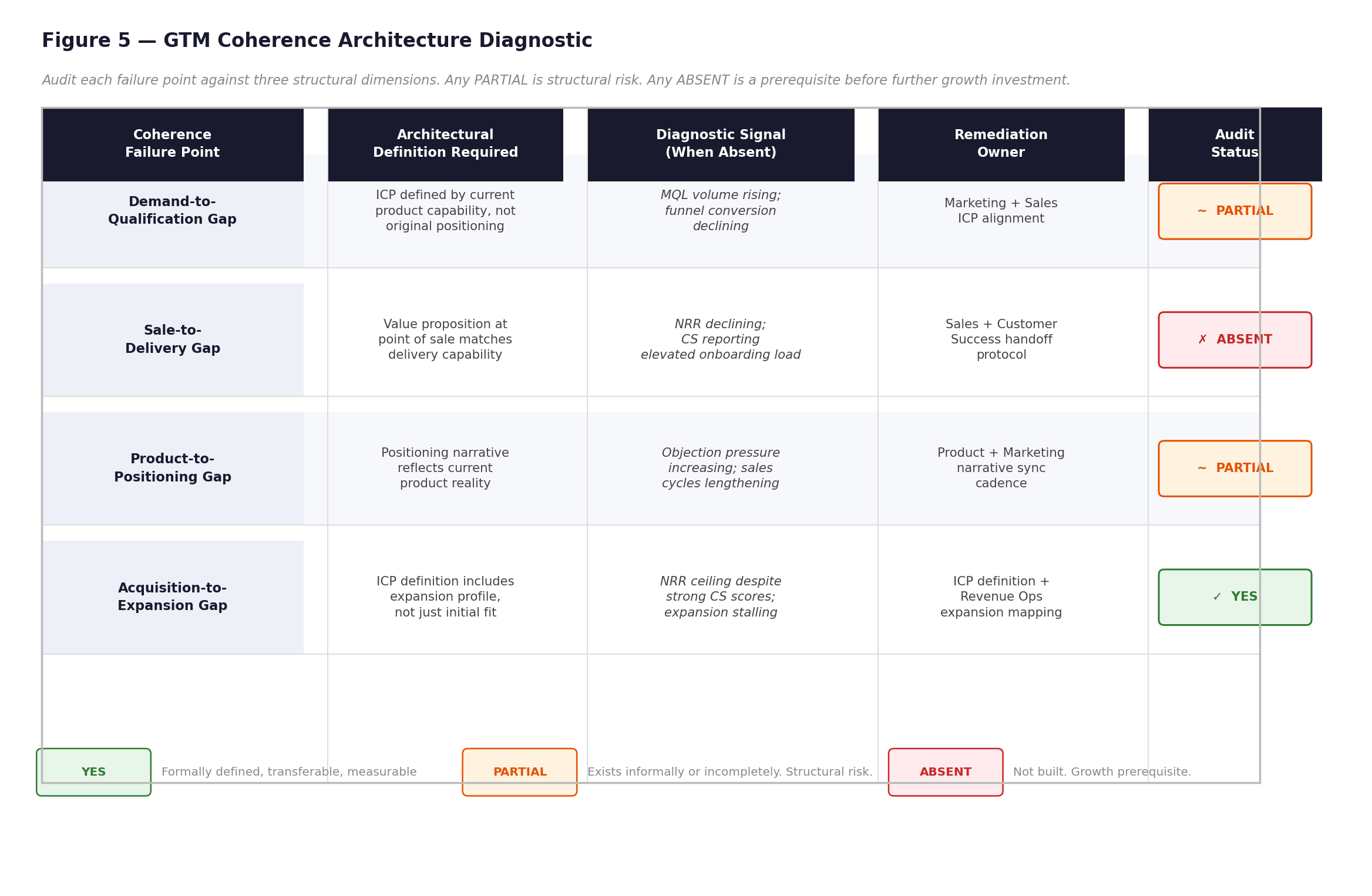
GTM coherence does not break uniformly. It fractures at four predictable structural points as organizations scale.
The demand-to-qualification gap
Marketing generates demand against a buyer definition and problem frame established, often informally, at an earlier stage of the company. As the product evolves and the ICP sharpens, that definition drifts. The leads Marketing generates reflect the original ICP rather than the current one. Sales qualifies them differently than Marketing scored them. Pipeline volume looks healthy. Conversion from top-of-funnel to closed revenue deteriorates. This is not a lead quality problem. It is a coherence failure between the demand-generation architecture and the current identity architecture.
The sale-to-delivery gap
The value proposition communicated during the sales process and the value the customer experiences during onboarding are frequently not the same proposition. Sales closes against outcomes. Delivery is designed around features. When the expectation formed by the sales motion does not match the experience shaped by the delivery motion, trust erodes before expansion is possible. This is not a Customer Success execution problem. It is a coherence failure between what the sale promises and what the system can deliver.
The product-to-positioning gap
Product makes decisions about what to build based on customer requests, competitive signals, and internal conviction. Marketing positions the product based on a narrative that may precede several of those decisions. When positioning does not reflect current product reality, the organization enters the field with a story its own product cannot fully support. Sellers experience this as objection pressure they cannot resolve. Buyers experience it as a gap between expectation and evaluation. It is not a messaging problem. It is a coherence failure between the product architecture and the GTM narrative.
The acquisition-to-expansion gap
The customers who close most easily are not always the customers who expand most reliably. When the acquisition motion is optimized for initial close without reference to the expansion profile of the resulting customer base, net revenue retention becomes structurally limited regardless of how well Customer Success executes. Coherence between acquisition and expansion requires that the ICP definition explicitly incorporates expansion potential, not just initial fit.
Case Study: Twilio (2021–2023)
Twilio entered 2021 as one of the fastest-growing infrastructure companies in SaaS. Revenue was compounding. Headcount was scaling. GTM investment was accelerating across every function.
The problem was structural. Twilio was running three fundamentally different GTM motions under one architecture. Its Communications business was developer-led and usage-based. Its Segment acquisition required an enterprise sales motion targeting data and marketing buyers. Its Flex contact centre platform needed a different buyer, a different sales cycle, and a different success structure again.
Each motion was active. None was coherent with the others.
By 2022, the signals were measurable. Dollar-based net expansion rate fell from 121 percent to 103 percent by year-end 2023. Three rounds of layoffs reduced headcount from approximately 8,800 to 5,600, a reduction of more than 35 percent in fourteen months. The cuts were not a market problem. Twilio’s core communications demand held. They were a GTM architecture problem.
In February 2023, CEO Jeff Lawson acknowledged the structural failure directly. Twilio split into two separate business units, Twilio Communications and Twilio Data and Applications, each with its own sales organisation, leadership, and GTM motion. Lawson stated publicly that the investment in Segment’s go-to-market had not produced expected growth outcomes, and that the unified structure had been slowing progress on both sides of the business simultaneously.
The intervention was architectural. Twilio did not fix a campaign. It did not retrain its sales team. It restructured the system.
Coherence was the missing input. Activity had never been the constraint.
The Coherence Architecture Diagnostic
Most organizations conducting a coherence audit for the first time discover that what appeared to be a collection of functional execution problems is in fact a single architectural problem expressing itself in four different places simultaneously.
The diagnostic question for each failure point is structurally identical: does the output of this function precisely match the input the next function requires to produce its best result?
If Marketing’s demand output does not match what Sales needs to qualify efficiently, the gap is at the demand-to-qualification point.
If Sales’ closed-won output does not match what Customer Success needs to deliver the promised value, the gap is at the sale-to-delivery point.
If Product’s output does not match what Marketing needs to position accurately, the gap is at the product-to-positioning point.
If the acquisition motion’s output does not match the expansion profile required for durable net revenue retention, the gap is at the acquisition-to-expansion point.
The answer to each question is not found in the metrics of the receiving function. It is found in the architectural definition governing the handoff between them.
Institutional Anchor
Markets reward systems whose functions amplify each other.
When coherence is present across the four structural points, each function’s output becomes the precise input that makes the next function more effective. Marketing generates demand that Sales can qualify with precision. Sales closes customers that Customer Success can deliver to at the level of value promised. Product builds what the market needs and positioning reflects what the product delivers. Acquisition identifies customers whose expansion profile supports the revenue model.
When coherence breaks, functions optimize independently and the system produces drag at every intersection. Revenue may continue to grow as individual functions improve their local execution. But the system’s output per unit of input declines and the organization works progressively harder to sustain growth rates it should be able to compound.
Foundational Law 03 is definitive:
Functional activity without coherence is structural dilution.
It produces the appearance of a performing system while compounding architectural debt at every functional boundary.
It cannot be resolved through coordination programs, communication improvements, or culture initiatives.
It requires an architectural intervention: formal definition of what each function produces, formal definition of what each function requires, and the structural discipline to maintain alignment between those definitions as the company and the market evolve.
Coherence is not a cultural achievement. It is an architectural requirement.
Activity is insufficient.
Architecture is required.
Doctrine Implications for Founders
Audit each of the four coherence failure points and determine whether the output of each function is precisely the input the next function requires.
Distinguish coordination failures from coherence failures before designing interventions. Meetings do not resolve architecture problems.
Maintain a formal, living coherence document that defines ICP, problem frame, value proposition, and expansion profile, updated when market or product reality changes.
Evaluate net revenue retention as the primary lagging indicator of sale-to-delivery coherence failure.
When win rates decline despite stable pipeline volume, investigate the demand-to-qualification coherence gap before adjusting sales execution.
Define the expansion profile of the target customer at the point of ICP definition, not after net revenue retention begins to decline.
Revenue stalls not because teams stop working. It stalls because the system stops matching how buyers evaluate, decide, and purchase.
Restore coherence. Then apply pressure.
This is the third law in the GTM Architecture series.
Foundational Law 01: Premature Scaling Is Structural Failure
Foundational Law 02: Pricing Is the Structural Expression of Value Expansion