The Premature Scaling Doctrine
The Foundational Law of GTM Architecture

Growth pressure is rising across the market.
But most revenue systems are not architected to absorb it.
Premature scaling is not an execution mistake. It is a sequencing violation.
This is Foundational Law 01 of GTM Architecture.
Foundational Law 01 of GTM Architecture
Sequencing Is Structural, Not Strategic
There is a structural failure pattern that repeats itself across venture-backed startups, bootstrapped SaaS businesses, and post-Series B organizations that appear externally successful but are, upon closer inspection, quietly fragile. The pattern almost always begins the same way. Early traction creates confidence. Confidence creates a mandate for expansion. And expansion is executed before the underlying go-to-market architecture has been fully engineered, because the people executing it have conflated the presence of revenue with the presence of a revenue system.
The result of this conflation is not immediate collapse, which is precisely why the mistake compounds so reliably across so many organizations. The result is gradual structural strain that surfaces slowly and unevenly: acquisition costs begin rising without a clear attributable cause, win rates soften in ways that appear to reflect market conditions rather than internal deficiencies, messaging becomes subtly inconsistent across functions, and a persistent sense of organizational friction begins to accumulate. It is a feeling, difficult to name but impossible to ignore, that the company is working measurably harder to produce the same level of commercial output it achieved with a leaner team and a smaller budget.
This is not a marketing problem, though marketing will absorb blame for it. It is not a sales training problem, though new training programs will be commissioned in response. It is not a demand generation problem, a positioning problem, or a hiring problem, although each of these functions will be prodded, restructured, and interrogated before the underlying cause is identified.
This article establishes the first foundational law of GTM Architecture: growth applied out of sequence creates structural drag that compounds faster than revenue itself. It is specifically an architectural sequencing violation, and it cannot be resolved through incremental tactical activity because tactics operate only on the surface of a system that is fracturing at its foundation.
Revenue compounds only when structural layers are engineered sequentially. Any attempt to bypass that sequence introduces coordination drag that outpaces the system’s capacity to absorb it.
PART I
The Structural Law of GTM Architecture
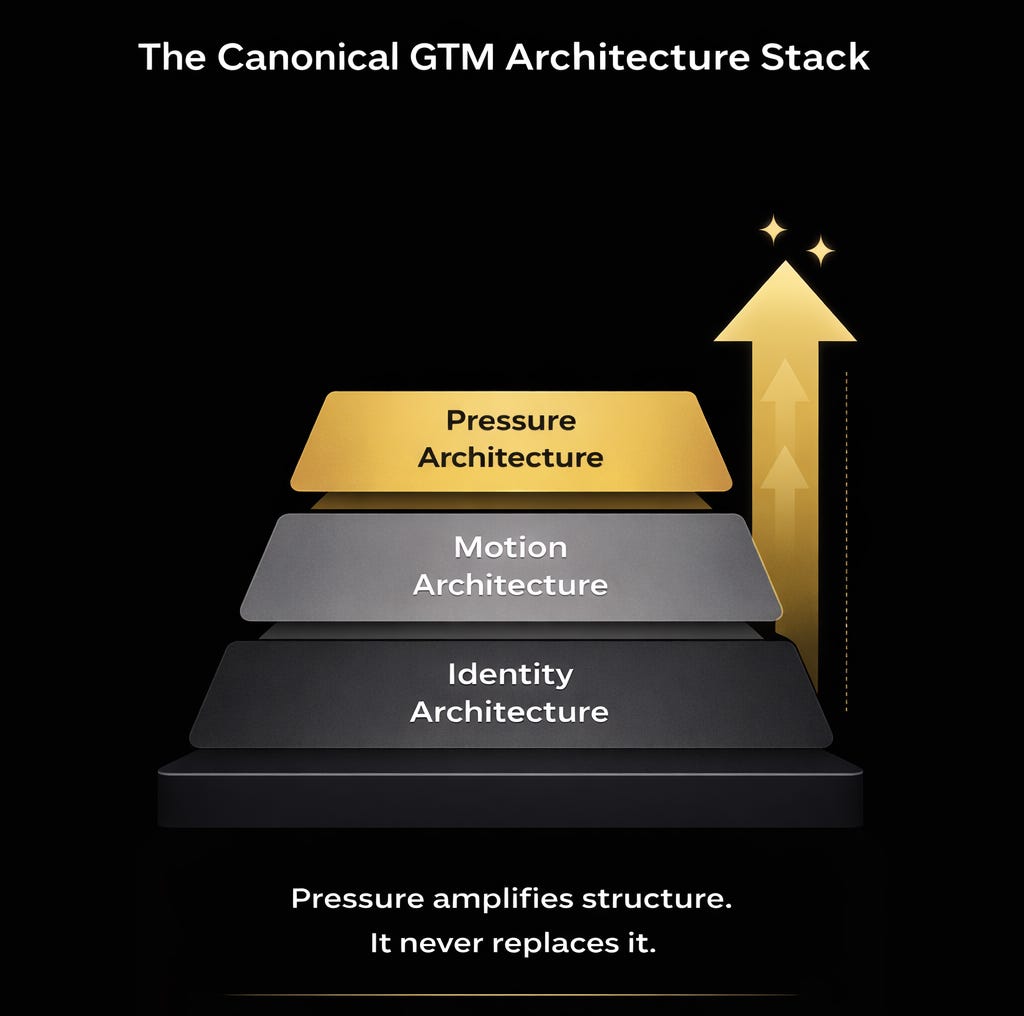
Every revenue system, regardless of the company’s stage, industry, or business model, matures through three hierarchical layers. Those layers cannot be compressed, rearranged, or skipped without introducing structural consequences that will eventually manifest as commercial underperformance. The sequence is not a strategic preference. It is not a methodology that practitioners can elect or decline based on their operating philosophy. It is a load-bearing reality, in the same sense that the structural layers of a building are load-bearing: violate the sequence and the structure above it will eventually fail under pressure.
The three layers are as follows. The first is Identity Architecture, the layer concerned with who the system is built to serve, what economic problem creates urgency for that segment, and how value is defined, packaged, and positioned in terms that align with buyer perception rather than internal product logic. The second is Motion Architecture, the layer concerned with how work moves reliably and repeatably across the revenue organization without depending on individual heroics or implicit institutional knowledge that has never been formalized. The third is Pressure Architecture, which most organizations refer to loosely as growth, meaning the controlled application of force to a system whose foundational layers have already been validated and stabilized.
The critical insight embedded in this sequence is that growth is not something that exists beside identity and motion in a horizontal relationship of parallel priorities. Growth is force applied downward onto the layers beneath it. When identity is unclear and motion is unstable, growth does not accelerate the system. It fractures it.
This sequencing principle is not advisory. It is structural.
Every advanced tactic discussed inside GTM Architecture — from AI-native orchestration to pricing leverage and multi-motion systems — will be evaluated against this law.
If Identity and Motion are not stable, Pressure multiplies instability.
This is not strategy. It is physics.
This is why companies that scale aggressively on the basis of early traction so frequently find themselves working harder for diminishing returns: they have applied downward pressure to a foundation that was not yet weight-bearing.
PART II
Layer I: Build -- Identity Architecture
The most underestimated layer of GTM Architecture is identity. Most companies declare it complete once revenue appears. That confusion is the root error behind most downstream failures.
Revenue is not evidence of identity clarity. Revenue is evidence that some buyers, under some circumstances, found sufficient reason to purchase. It reveals nothing, in itself, about whether that revenue was produced by a coherent and repeatable identity system or by a combination of founder relationships, early adopter enthusiasm, competitive displacement opportunism, and the kind of informal positioning alchemy that skilled salespeople perform intuitively but cannot transfer to others. The question Identity Architecture is designed to answer is not whether the company has made sales. It is whether the commercial motion could be reconstructed by someone who had access only to the formal, documented system, without access to the tacit knowledge of the people who built it.
Properly engineered Identity Architecture requires precise definition across five interdependent dimensions. The first is segment clarity: an explicit, operationally specific identification of who the system is designed to serve, written in terms specific enough to be used as a qualification filter rather than a general aspiration. The second is problem specification: a rigorous articulation of the recurring, economically urgent problem that creates buying urgency in that segment, not the problem the product was built to solve in the abstract, but the problem as the buyer actually experiences and prices it. The third is value packaging: the translation of internal product capability into externally meaningful outcomes that align with how buyers measure and communicate value within their own organizations. The fourth is pricing architecture: a structure that reflects actual value realization milestones rather than historical deal averages or competitive benchmarking. The fifth is category narrative: the broader competitive and conceptual frame within which the product is positioned, which shapes buyer expectations and comparison sets before any sales conversation begins.
When any of these five dimensions is only partially defined, even partially rather than completely absent, every function downstream compensates through interpretation. Marketing selects audiences based on surface-level proxies. Sales qualifies on instinct rather than documented criteria. Customer Success inherits onboarding expectations that were never formally designed. Product builds in response to anecdotal feedback unweighted by segment priority. Over months, these interpretations diverge from one another and from any coherent central identity, producing what might be called narrative drift: a quiet, cumulative erosion of the coherence that makes conversion predictable.
Case Study: The Multi-Segment Illusion
A $5M ARR vertical SaaS company believed it had achieved broad product-market fit because it had successfully closed customers across three distinct industries. Encouraged by investors who read the breadth of customers as a signal of market size, leadership allocated acquisition budget evenly across all three segments and began expanding paid channels and headcount accordingly.
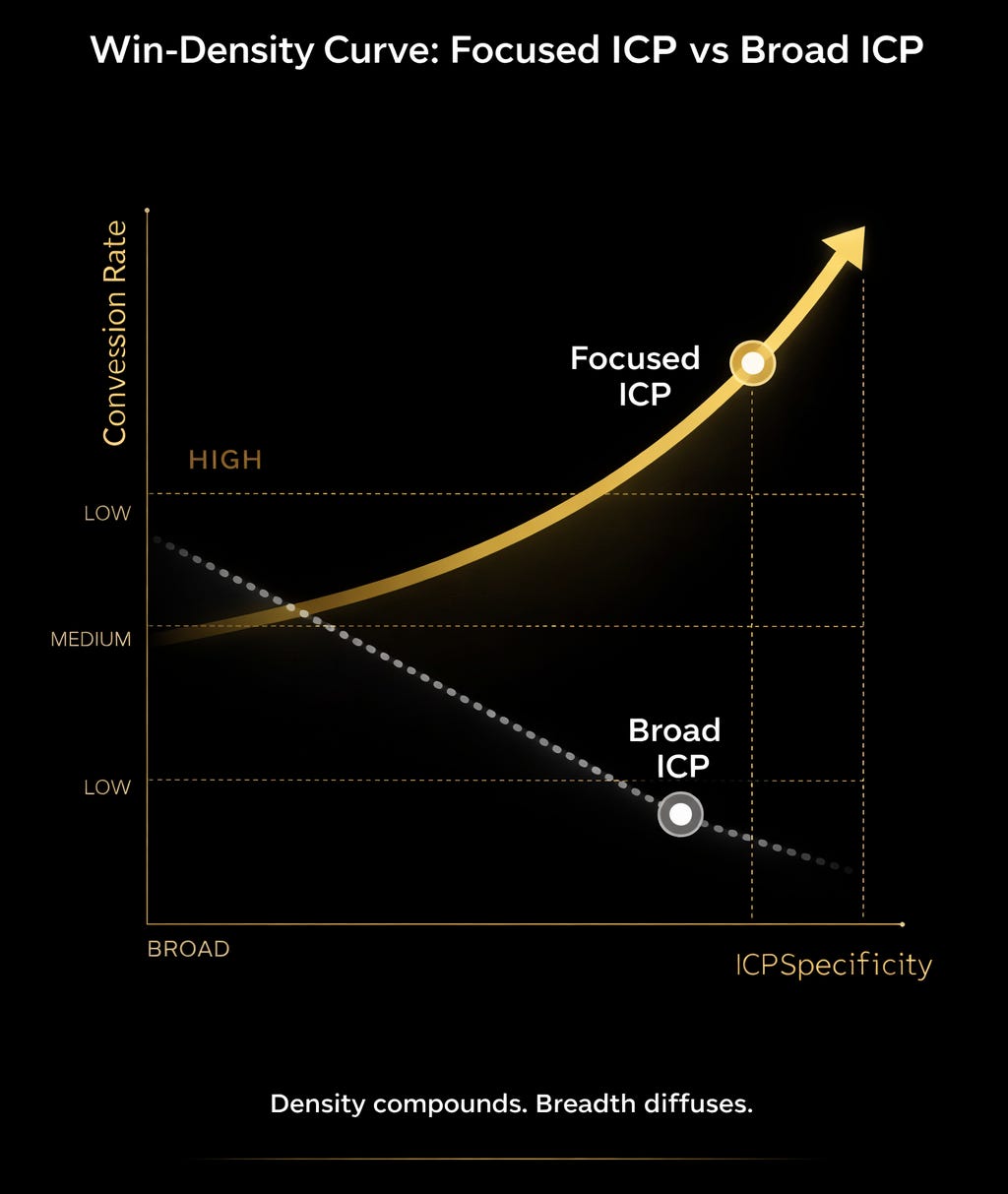
A Build-layer audit conducted before the next growth investment revealed something the revenue numbers had concealed. While deals were closing across all three industries, 68 percent of expansion revenue and 74 percent of net retention were concentrated in a single vertical. The other two segments required materially longer sales cycles, heavier onboarding support, and custom feature development that was silently diluting roadmap focus and engineering capacity. Messaging on the website had been deliberately kept generic in order to avoid alienating any of the three audiences, which had the effect of resonating weakly with all of them rather than powerfully with any.
The company was scaling breadth instead of density. Once ICP prioritization was formally codified around the dominant vertical, positioning was rewritten in that segment’s operational language, packaging was simplified around the primary use case, and pricing was aligned to the activation milestones that mattered specifically to that buyer. Win rates increased by double digits and CAC declined within two quarters, with no new channels introduced, no additional headcount added, and no tactical changes made to the acquisition motion whatsoever. Identity was engineered. The system responded accordingly.
The diagnostic question for Identity Architecture completeness is deliberately uncomfortable to answer with precision: if every founder and senior go-to-market leader left the company tomorrow, would the system continue to attract, qualify, and convert the right buyers at the same rate, because the identity was documented, formalized, and embedded into the operational logic of every customer-facing function? If the answer is anything other than yes, identity work is incomplete, regardless of current ARR.
PART III
Layer II: Operate -- Motion Architecture
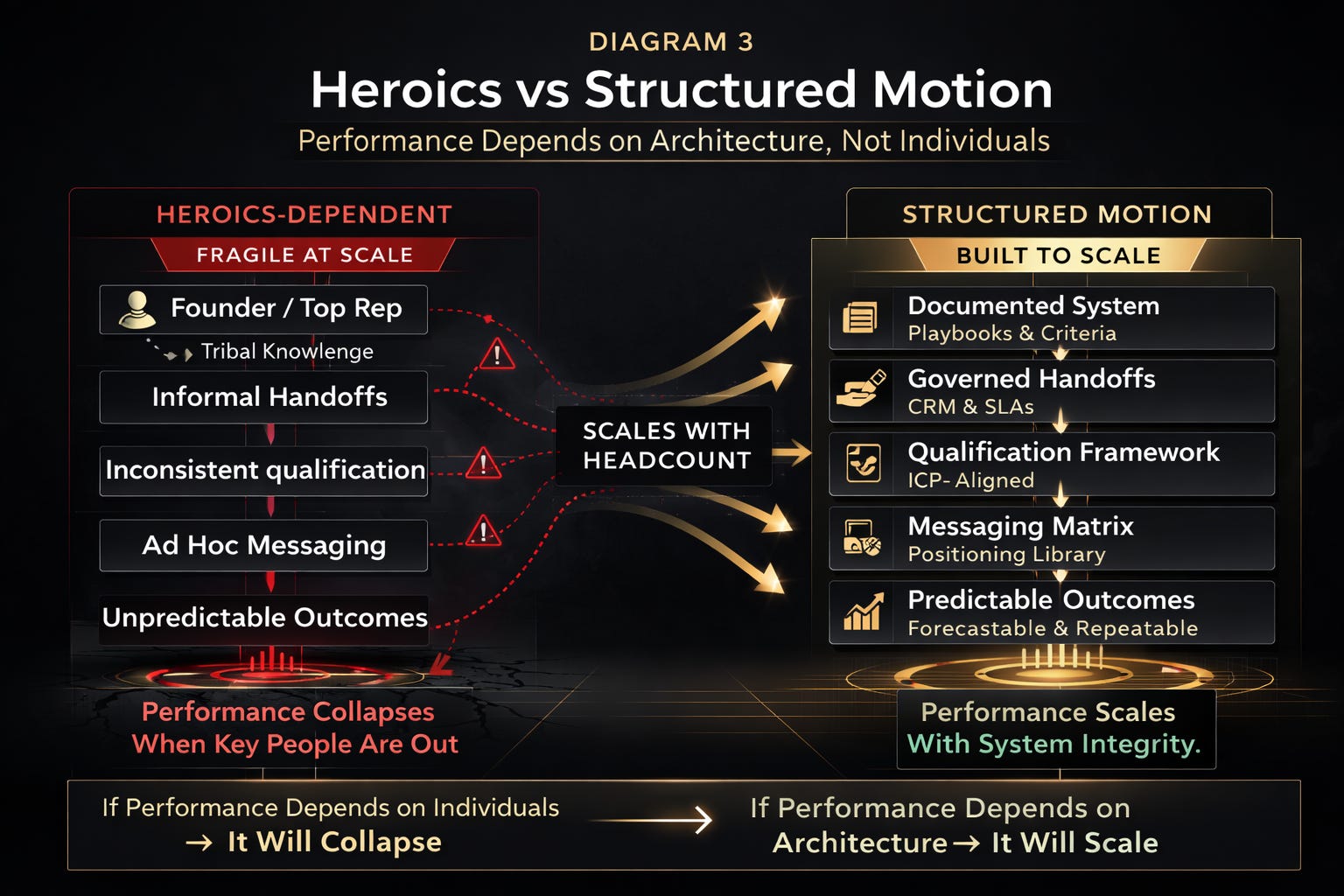
Once identity has been engineered to the standard described above, specific enough to function as an operational filter rather than merely a strategic aspiration, the system must be able to execute that identity consistently, at increasing volume, without requiring constant intervention from the people who designed it. Revenue systems that can only perform reliably when founders are directly involved in qualification decisions, or when senior sellers are compensating for undefined messaging through personal persuasion, or when executive escalation is the standard mechanism for resolving stalled deals, are not scalable systems. They are manually stabilized structures whose stability is an artifact of the individuals maintaining them, not the architecture underneath.
Motion Architecture is the formalization of how work moves across the revenue organization in ways that are transparent, transferable, and continuously improvable. It encompasses qualification logic that operationalizes ICP criteria rather than relying on individual judgment; CRM stage governance that reflects actual buyer progression and decision milestones rather than internal optimism; structured handoffs between SDRs, Account Executives, and Customer Success that eliminate the ambiguity responsible for most transition-stage revenue leakage; objection categorization systems that convert the qualitative texture of sales conversations into quantitative insight routed back into positioning strategy; activation playbooks that define value realization at each stage of the customer journey; and feedback loops that transmit structured signal from customer-facing teams into Product and Marketing in a form that is actionable rather than anecdotal.
In the earliest stages of a company, many of these elements exist in an informal state that functions adequately at low volume. Founders carry qualification logic implicitly. High-performing sellers compensate for messaging ambiguity through conversational instinct. Customer Success resolves onboarding gaps through personal persistence rather than documented process. These compensatory behaviors are often mistaken for organizational capability, because they produce results. The mistake is not recognized until the organization attempts to replicate those results at scale and discovers that the results were never produced by the system in the first place. They were produced by the people.
Case Study: The Scaling Stall
A Series A SaaS company scaled from 12 to 32 sales representatives within nine months following a successful capital raise, operating under the assumption that pipeline volume was sufficient justification for aggressive hiring. Within two quarters, win rates dropped from 27 percent to 15 percent, sales cycle length increased substantially, and forecasting accuracy deteriorated to the point where quarterly projections were consistently unreliable.
The initial diagnosis focused on lead quality, the most visible variable and the one most amenable to tactical intervention. A deeper Motion Architecture audit produced a different finding. Qualification standards were inconsistent across the expanded team, with individual reps applying materially different criteria to similar opportunities. CRM stage definitions did not reflect actual buyer decision milestones, which meant pipeline reports were measuring internal intent rather than buyer progression. Handoffs between SDRs and Account Executives were undefined in a way that created systematic ambiguity at the highest-leverage transition point in the funnel. And there was no centralized mechanism for capturing and analyzing recurring objections, which meant that resistance patterns were never converted into positioning adjustments.
Revenue had previously been carried by a small group of senior sellers who intuitively filtered deals and adjusted messaging in real time. When headcount nearly tripled, that intuition, which had never been institutionalized, could not be replicated. After formalizing qualification criteria, aligning CRM governance with documented buyer behavior, implementing structured handoff protocols, and creating a centralized objection intelligence repository, win rates stabilized and forecasting accuracy recovered. The company did not need more leads. It needed motion integrity.
QUANTITATIVE ANCHOR
The Coordination Drag Formula
Motion failure under scale follows a mathematical relationship most revenue leaders feel but rarely name. Understanding it changes how premature headcount investment is evaluated.
When a revenue organization lacks formalized Motion Architecture, meaning qualification logic, handoff protocols, stage governance, and objection taxonomy exist only in the implicit knowledge of the people currently executing them, every new hire added to that system creates a new set of potential coordination breakdowns. The number of pairwise coordination links in a team of n people is given by the formula n(n-1)/2, which means that coordination complexity does not grow linearly with headcount. It grows polynomially. A team of 5 has 10 coordination links. A team of 12 has 66. A team of 32 has 496. Each of those links is, in the absence of formalized motion, a potential point of narrative divergence, qualification inconsistency, or handoff failure.
The table below models what this relationship looks like empirically across the case studies described in this essay and the broader pattern observed across revenue organizations that scaled before Motion Architecture was formalized. The Drag Index normalizes coordination complexity against the 5-person baseline, and the win rate and CAC columns reflect the observed range of outcomes across organizations at each headcount threshold operating without motion governance.
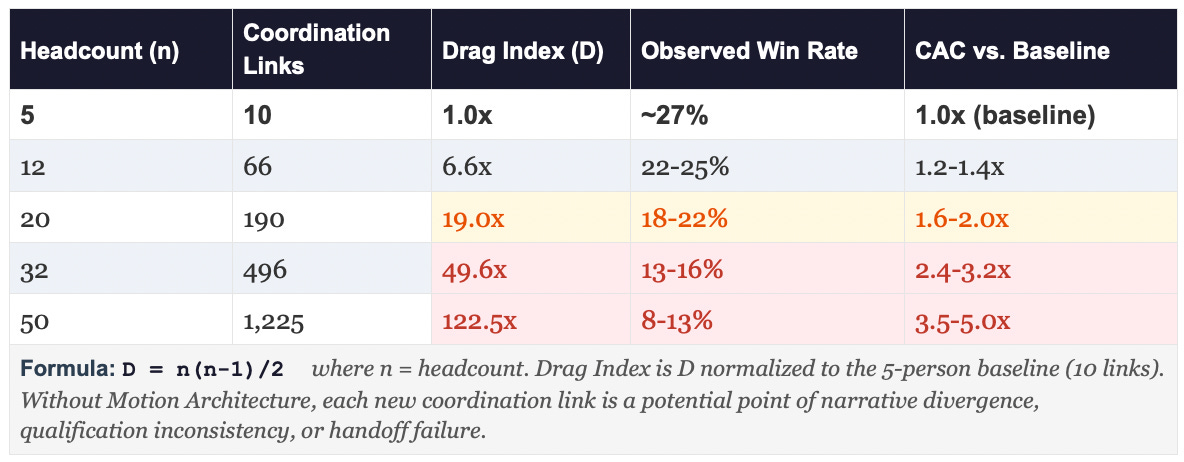
The implication is significant: at 32 people, an architecturally immature revenue organization is managing nearly 50 times the coordination complexity of its 5-person predecessor, which explains why win rates in the Scaling Stall case declined from 27 percent to 15 percent as headcount nearly tripled. The additional sellers did not add 2.5x the revenue-producing capacity. They added 7.5x the coordination complexity, applied to a system that had no formal mechanism for managing it. The result was not additive underperformance. It was compounding fragmentation, with each new hire reconstructing the motion slightly differently and each reconstruction pulling the system further from the coherence that had produced the original win rates.
In venture-backed environments, this drag is often misread as temporary inefficiency instead of structural mis-sequencing.
PART IV
Capital Misallocation Through Sequencing Violation
When growth capital is deployed into acquisition channels before Identity and Motion are stable, capital does not increase throughput. It increases coordination cost.
From the outside, increased spend appears to be acceleration. Internally, structural drag rises faster than pipeline.
Premature scaling is not only a GTM mistake. It is a capital allocation error.
Architecture determines whether capital compounds into durable throughput or is absorbed as organizational friction disguised as growth investment.
Layer III: Grow -- Pressure Architecture
Growth, within the framework of GTM Architecture, is not synonymous with experimentation, and it is not a continuous process that begins at company inception and runs in parallel with identity and motion development. It is controlled pressure applied to a system that has been verified to be structurally stable, a deliberate amplification of commercial throughput that is only productive when the layers beneath it can bear the load.
Pressure Architecture includes the full spectrum of growth levers that revenue leaders typically associate with scale: segment expansion to adjacent ICPs, pricing leverage strategies that extract greater value from existing customers, channel portfolio diversification to reduce concentration risk and access new buyer pools, internationalization, multi-motion orchestration across inbound, outbound, and partner-led motions, expansion SKU development, and the governance mechanisms required to ensure that each increment of additional complexity introduced by growth initiatives does not degrade the structural coherence of the identity and motion layers beneath them.
The common failure mode at this layer is not the absence of ambition but the premature application of growth pressure to a system that has not yet demonstrated structural stability under its current load. Consider the case of a mid-market infrastructure company with strong retention characteristics among customers at $50,000 ACV, whose leadership, seeking to improve revenue model economics by pursuing larger contracts, directed the sales organization toward enterprise accounts without adjusting any of the underlying system components those accounts require: qualification logic calibrated to enterprise buying cycles and committee structures, proof assets credible at the executive level, pricing governance that accounts for enterprise procurement requirements, and onboarding infrastructure scaled to enterprise implementation complexity.
Enterprise opportunities entered the pipeline and appeared attractive by ACV alone, which concealed the absence of enterprise-grade qualification logic, executive-level proof assets, pricing governance, and onboarding infrastructure. But because the structural components required to convert and retain enterprise accounts had not been engineered in advance of the motion, the expansion increased organizational complexity without increasing commercial efficiency. Sales cycles lengthened without producing proportionally larger closed revenue. Resources were diverted from the mid-market segment that had demonstrated structural stability to pursue enterprise deals the system was not equipped to close. When the company paused its expansion motion, re-engineered enterprise identity and motion components before reintroducing growth pressure, the motion scaled coherently, not because the growth ambition had changed, but because the architectural prerequisites had been honored.
This is the central principle of Pressure Architecture: growth is the final applied force, not the starting point. The sequencing is not a bureaucratic constraint. It is the operational expression of how structural systems actually behave under load.
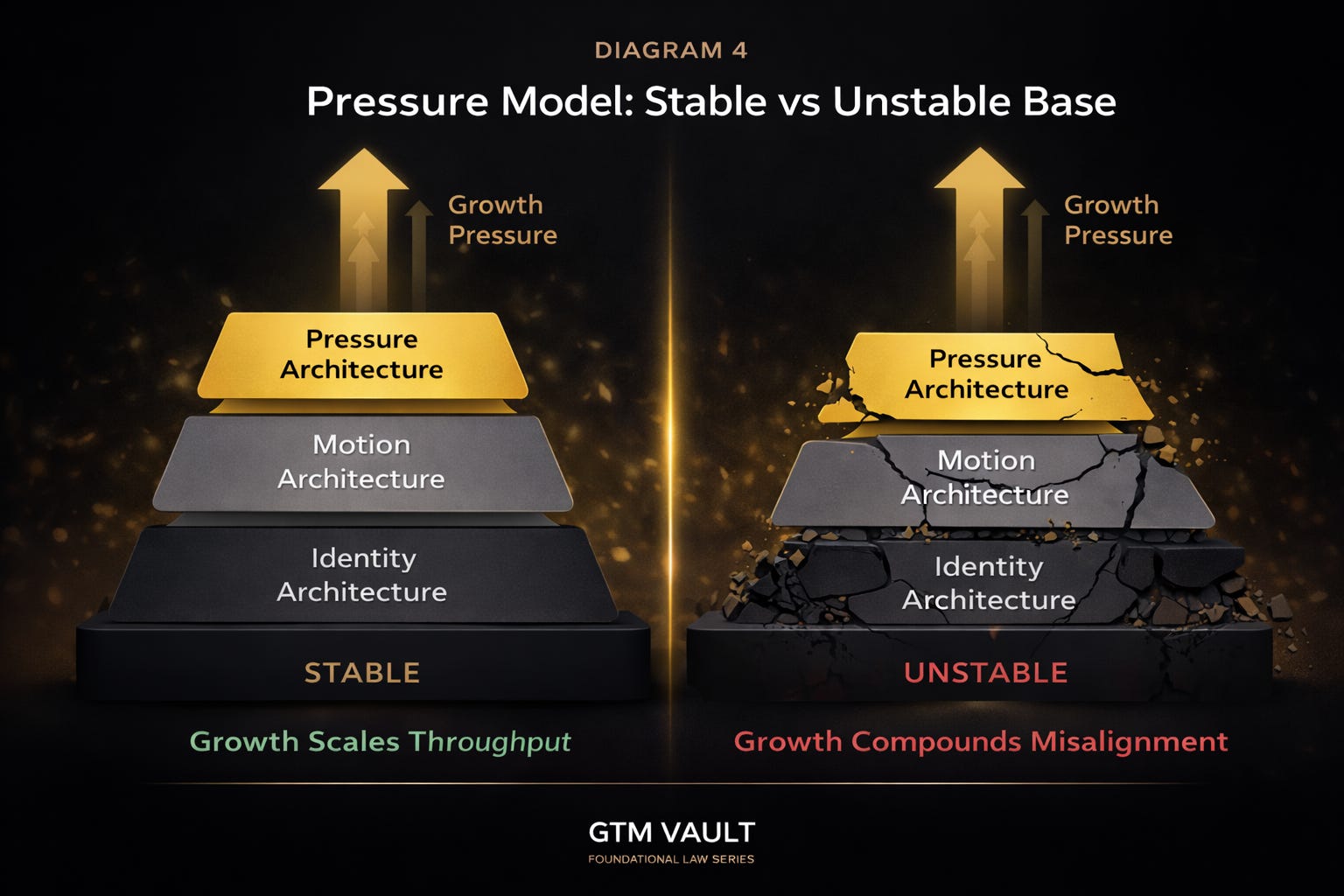
Pressure reveals architecture. It does not create it. A system that cannot sustain its current load will not be strengthened by adding more weight. It will be broken by it faster.
PART V
The Premature Scaling Pattern
The failure sequence described throughout this essay follows a consistent and recognizable pattern across hundreds of revenue organizations, regardless of their stage, their industry, or the sophistication of their leadership teams. Understanding the pattern in sequence is essential because each stage in the progression appears, at the time it is occurring, to be a reasonable and evidence-based response to the conditions preceding it. This is precisely why the pattern persists even in organizations staffed by experienced operators who have encountered versions of it before.
The sequence begins with early traction, which is real and which creates a legitimate and rational basis for optimism. Optimism, in the context of a growth-oriented organization with investor expectations to meet, generates pressure to expand the system’s surface area -- more channels, more segments, more headcount, more product investment -- before the foundation has been validated as weight-bearing. Surface area expansion increases coordination complexity at the polynomial rate described in the drag formula above, which produces drag that is subtle at first and tends to be interpreted as a scaling challenge to be managed rather than an architectural signal to be investigated. As drag accumulates, narrative coherence across the organization begins to decline. Different functions are operating from subtly different assumptions about who the product is for, what it does, and why it wins. That incoherence begins to erode conversion integrity at every stage of the funnel.
Win rates soften. Sales cycles lengthen. Customer acquisition costs rise without a clear attributable cause. The system’s output per dollar of input begins declining, and leadership responds at the tactical level: adding activities, running new experiments, restructuring teams, introducing new tools. These interventions address the surface presentation of the problem without touching its architectural root, which means that each intervention adds further complexity to a system already struggling under coordination drag, and the additions compound the very problem they were designed to solve.
PART VI
The Canonical Diagnostic
There is a single diagnostic question that reliably distinguishes between revenue systems that are structurally mature and those that are momentum-driven: between organizations whose commercial performance is a function of architectural coherence and those whose performance is a function of the energy and individual talent currently being applied to a system that has not yet been properly built.
The question is this: if you froze all hiring and all marketing spend for ninety days, would the system continue to produce predictable revenue with stable conversion rates, consistent messaging across every customer-facing function, and forecasting accuracy sufficient to make operational planning credible?
If the answer is yes, the system has achieved a meaningful degree of structural maturity. If the answer is no, if the honest assessment is that revenue depends on the continued application of energy to a system that would begin to stall without that constant input, then the system is momentum-driven rather than structure-driven, and the appropriate intervention is not more momentum. It is architectural investment in the layers that have been bypassed or incompletely engineered in the pursuit of scale.
This is not a comfortable diagnostic, because it tends to reveal that organizations which have raised capital on the basis of their growth metrics are not yet ready to deploy that capital into growth. That conclusion requires significant organizational courage to act on, particularly when investor timelines and competitive pressure are generating urgency in the opposite direction. The counterintuitive reality is that the investment required to complete identity and motion architecture, when properly sequenced, produces a more efficient and more durable commercial system than the same capital deployed into growth pressure on an architecturally immature foundation.
PART VII -- OPERATIONAL INSTRUMENT
The False YES Problem
In architectural audits, most teams over-score themselves.
A YES does not mean someone can answer the question in a meeting.
A YES means the element is documented, transferable, measurable, and executable by a new hire without interpretation.
If it lives in someone’s head, it is not a YES.
If it requires explanation, it is not a YES.
If it degrades under hiring pressure, it is not a YES.
Treat PARTIAL in Layer I or II as structural debt.
The GTM Architecture Structural Audit
The framework described in this essay is not intended to function only as a conceptual model. It is designed to be applied. The instrument for applying it is the nine-block Structural Audit Grid below. Each cell in the grid represents the intersection of a GTM Architecture layer (Build, Operate, Grow) and a diagnostic dimension (Identity Signal, Motion Signal, Pressure Readiness), and each intersection contains a governing question designed to surface whether that dimension has been formally engineered or is still operating on the basis of institutional informality.
The grid should be completed honestly and without the benefit of optimistic interpretation, which requires that every question be answered from the perspective of documented, transferable, formal systems rather than from the perspective of what experienced individuals currently know how to do. The distinction is the entire point. A YES answer means that the capability exists in writing, is embedded in operational tooling, and would survive the departure of the individuals who designed it. A PARTIAL answer means the capability exists informally or incompletely. A NO answer means it has not been built. Organizations should treat any NO in Layer I or Layer II as a structural prerequisite that must be resolved before growth investment is made, and any PARTIAL as a risk-weighted liability that will compound under scale.
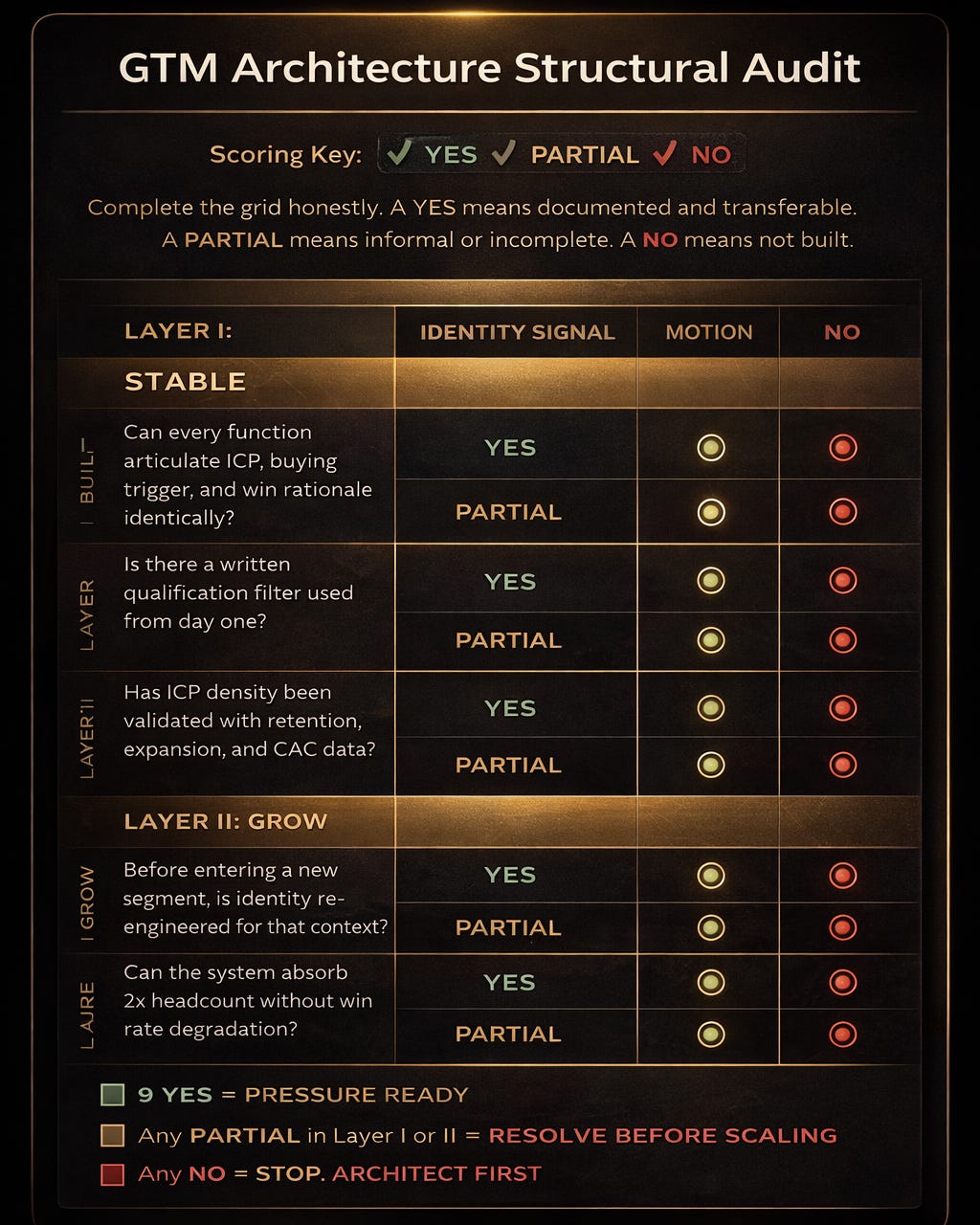
The purpose of this instrument is not to produce a score but to produce a structural inventory: an honest accounting of which layers of the revenue architecture have been formally engineered and which are still being carried informally by the people currently in place. Most organizations conducting this audit for the first time discover that they have answered several cells in Layer I and Layer II as PARTIAL without having previously recognized the operational significance of that incompleteness. The grid makes the risk visible before it becomes a crisis.
Most organizations discover, on their first honest audit, that they have been operating with structural debt they never had a name for. The grid gives them the name and a place to start.
CONCLUSION
Architectural Discipline as Competitive Advantage
Architectural discipline is a competitive advantage.
Identity aligns the system. Motion stabilizes execution. Pressure multiplies load.
Premature scaling does not fail loudly. It accumulates structural debt until remediation becomes expensive.
Markets do not reward ambition. They reward architectural coherence.
Identity first. Motion second. Pressure third.