Foundational Law 02 of GTM Architecture
Pricing Is the Structural Expression of Value Expansion

Executive Summary
Pricing in the AI era is no longer a subscription packaging decision. It is a structural alignment problem between cost exposure, value realization, and budget capture.
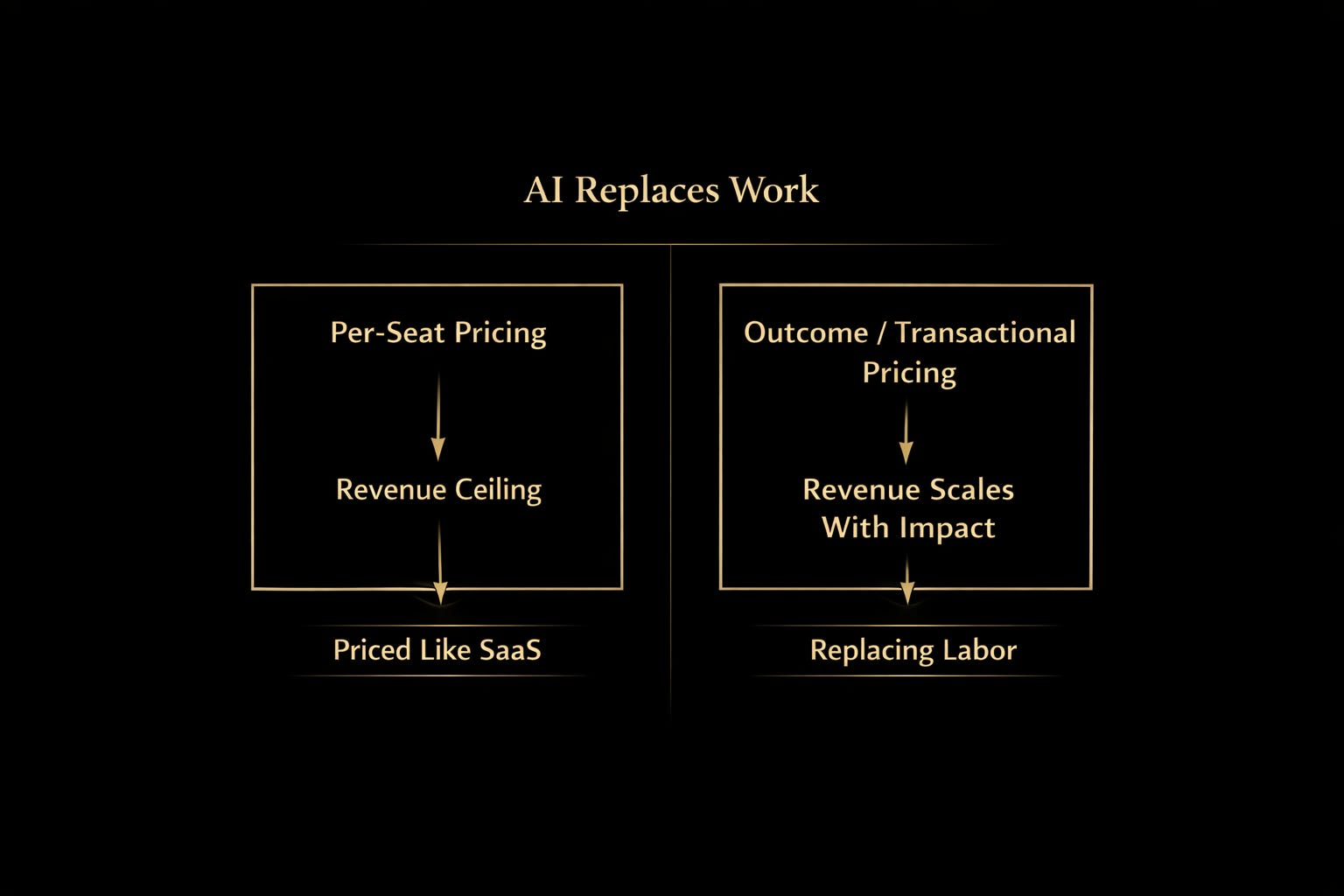
For example, if your AI replaces three analysts but you price per seat, your revenue no longer scales with the value you create. You are displacing labor economics while capturing software economics. The mismatch compounds as adoption grows.
AI-first companies increasingly compete against fully loaded labor costs, not just other software vendors. This shift changes pricing logic. Seat-based models optimize predictability but often undercapture value when automation replaces human effort. Transactional models capture value more directly but introduce volatility. Hybrid architectures anchor predictability while enabling elastic expansion.
This law establishes five structural truths:
Pricing must mirror the dimension in which value expands.
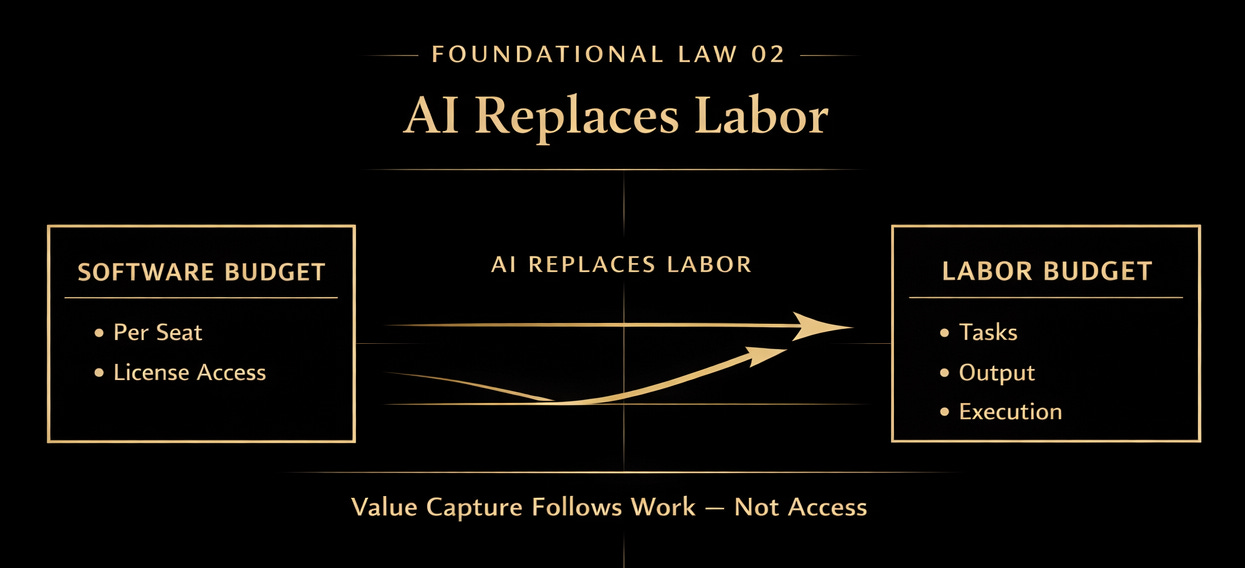
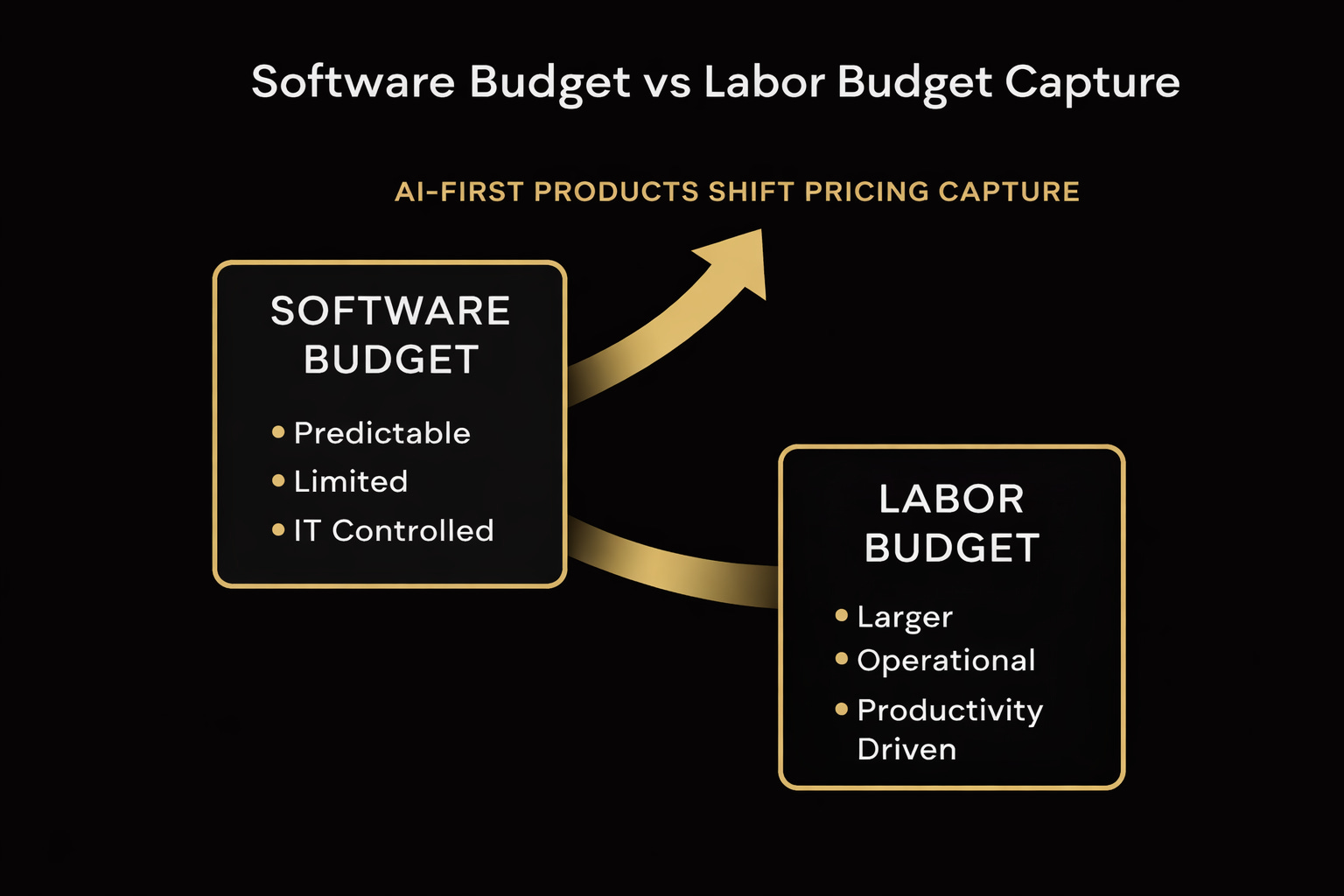
AI shifts competition from software budgets toward labor budgets.
Predictability supports valuation. Elasticity supports value capture.
Hybrid architectures reconcile margin st›ability with economic efficiency.
Misalignment distorts product-market fit signals.
Organizations that treat pricing as architecture design durable economic systems. Organizations that treat pricing as arithmetic amplify fragility at scale.
The broader system-level framing of pricing as a go-to-market architecture decision is developed in Episode 37: Pricing Is the GTM System.
The Structural Failure Pattern
A recurring pattern is emerging across AI-native companies.
The company adopts a pricing model inherited from traditional SaaS. Early traction validates the product. Usage scales unevenly. A small percentage of customers drive disproportionate compute costs. Sales begins discounting to close deals in response to procurement resistance. Revenue grows, but margin compresses. Forecasting becomes less reliable. Expansion becomes negotiation-heavy.
AI removes the margin buffer traditional SaaS relied on. When value replaces labor instead of licenses and cost exposure becomes variable, pricing must adjust or margin erodes as revenue grows.
The Structural Principle
Pricing must capture value in the same dimension in which value expands.
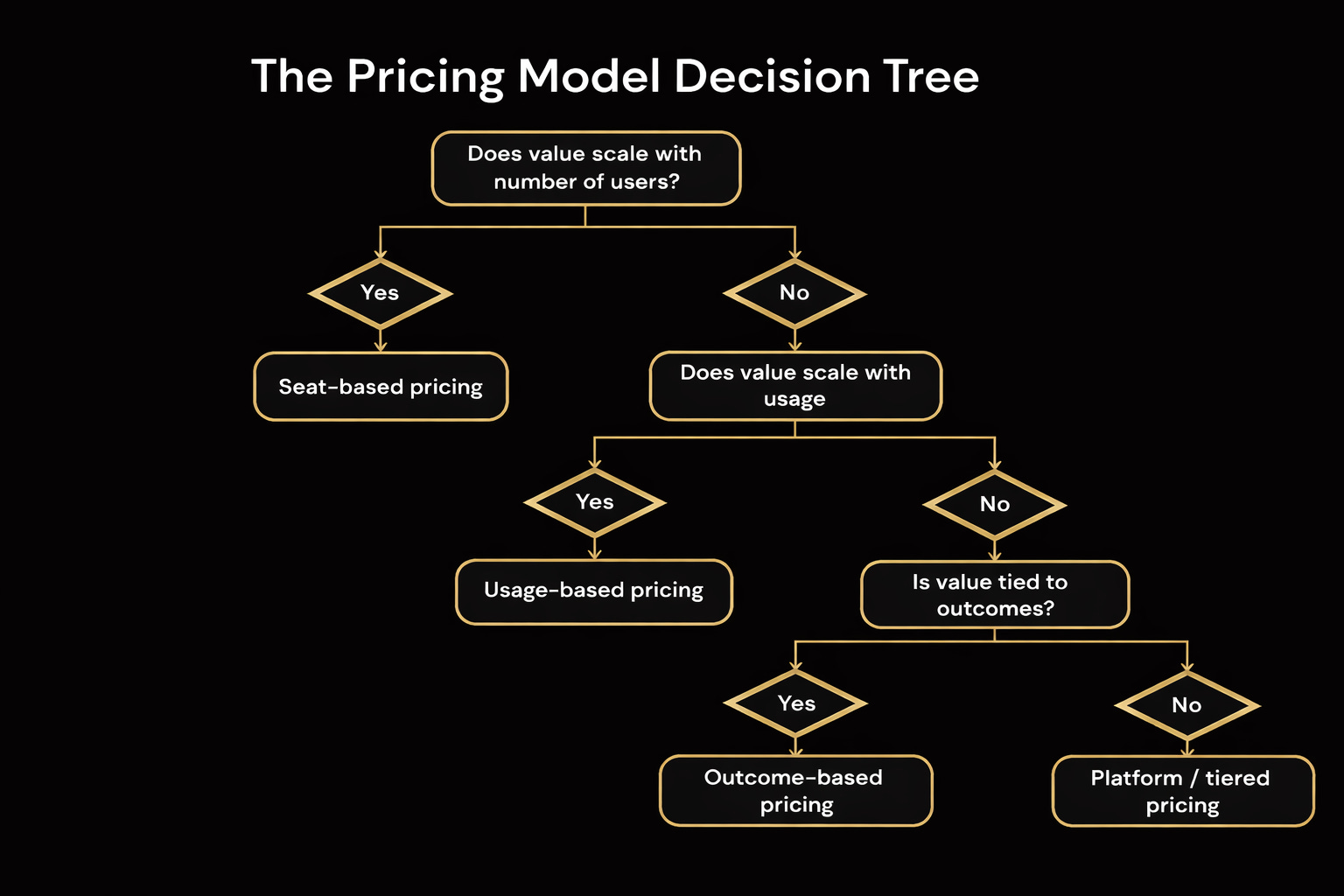
If value expands through additional human users, seat-based pricing is coherent.
If value expands through consumption, usage-based pricing is coherent.
If value expands through completed work, output-based pricing is coherent.
If value expands through workflow centrality, platform pricing is coherent.
When pricing captures value in a different dimension than it is realized, friction appears in discounting, procurement delay, churn, and stalled expansion.
Dimensional alignment is the governing principle.
The Labor Budget Shift
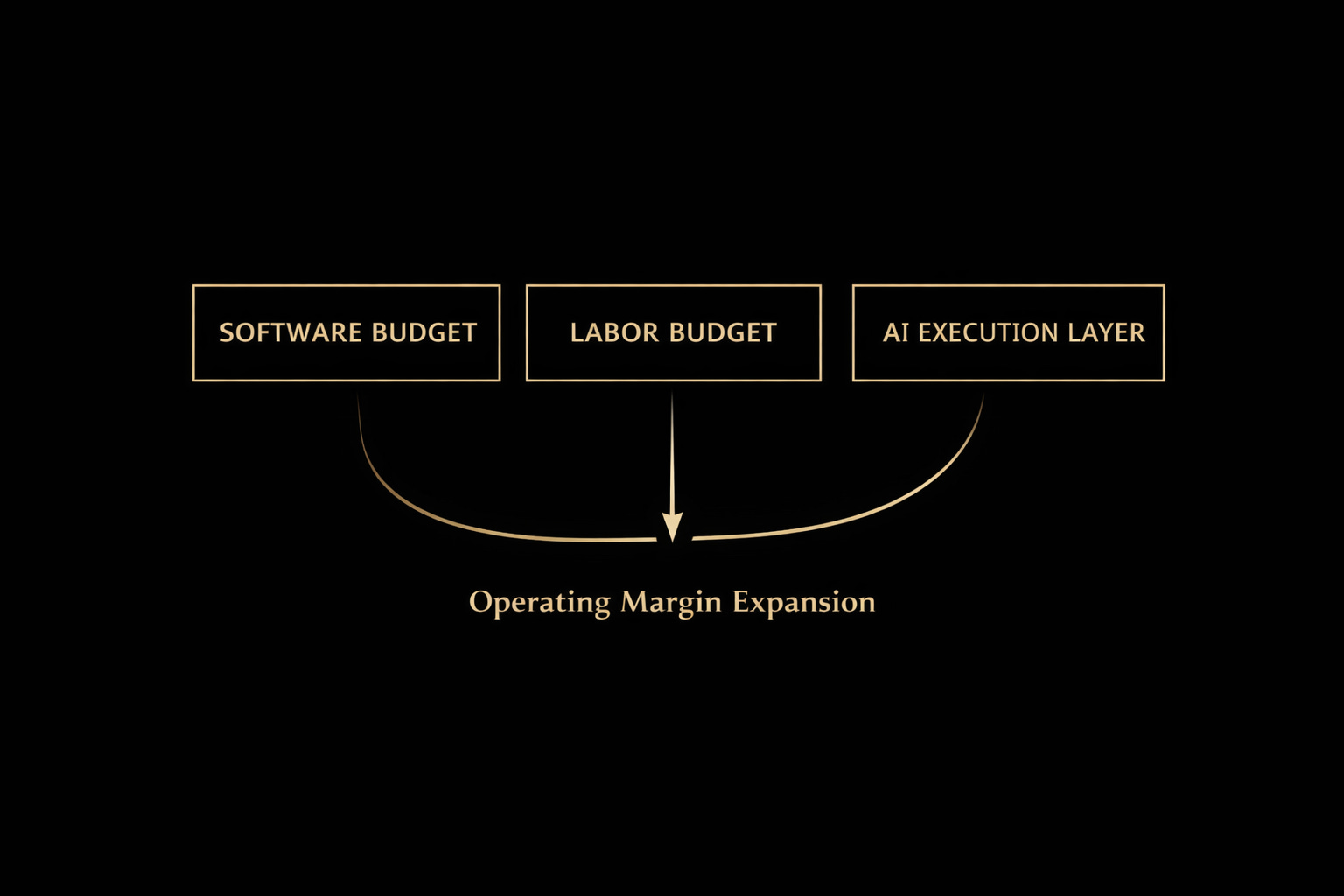
AI-first companies frequently replace or materially augment human labor. This creates a strategic decision that did not exist in traditional SaaS.
Are you selling into a software budget, or are you displacing a labor budget?
Labor budgets are typically larger, more mission-critical, and tied directly to operational output. Software budgets are constrained, predictable, and managed within IT frameworks.
When replacing labor, pricing should reference fully loaded employee cost, including salary, benefits, management overhead, training, and attrition risk. Charging within SaaS conventions undercaptures labor displacement economics.
This shift expands total addressable market but requires architectural discipline.
If you are competing against labor, your pricing logic must reflect labor economics.
Predictability Versus Elasticity
Traditional SaaS models command higher public market revenue multiples largely due to predictability. Annual contracts, upfront payments, and stable recurring revenue create strong forecasting confidence.
Transactional models, particularly output-based models, often capture more economic value because revenue scales directly with completed work. However, revenue volatility increases. Boards and investors may discount valuation in response to forecasting variability.
Predictability increases valuation multiple. Elasticity increases value capture.
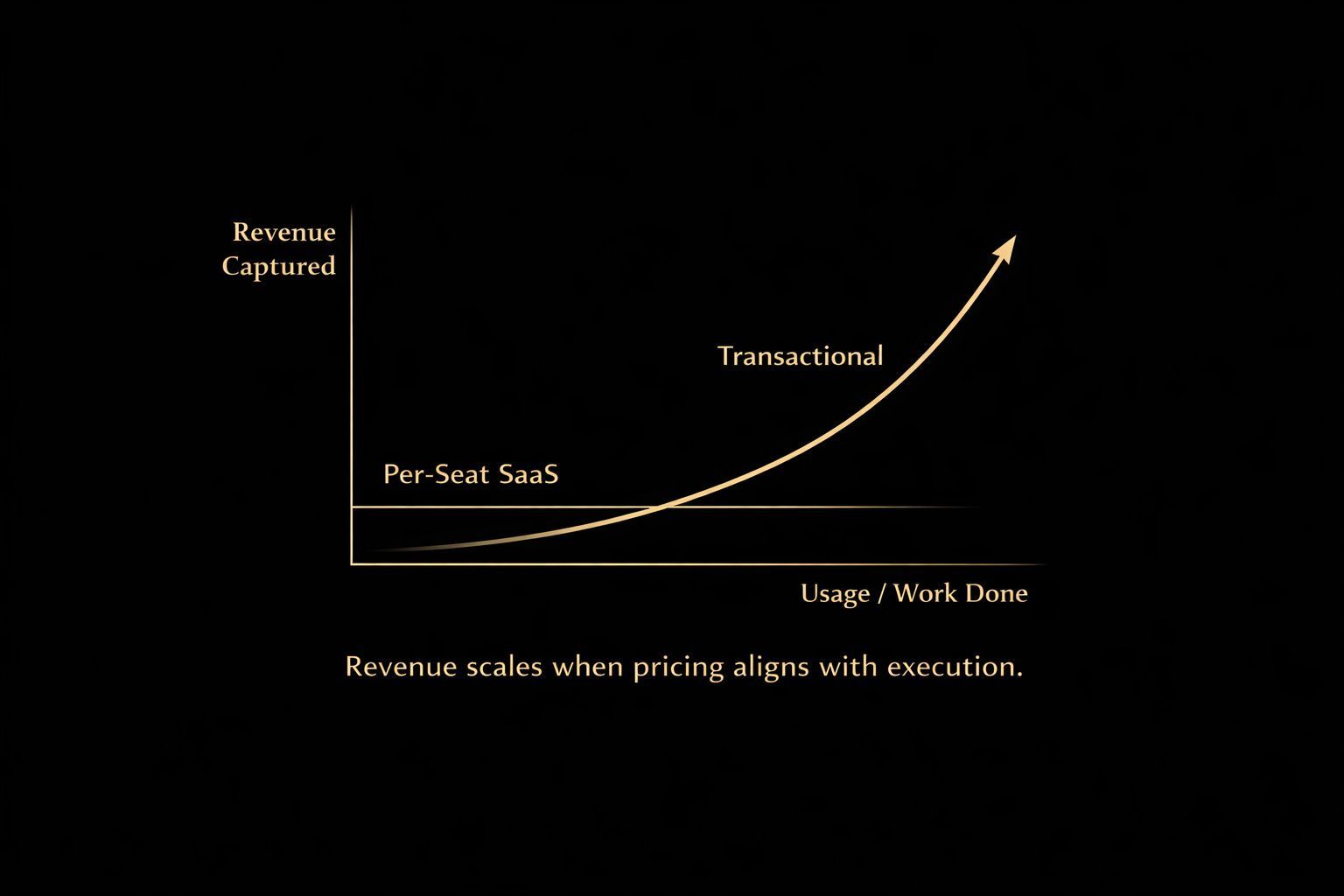
Hybrid pricing architectures attempt to reconcile these forces by anchoring baseline subscription revenue while layering consumption or output-based expansion mechanisms.
Hybrid is not compromise. It is equilibrium between financial stability and economic efficiency.
Input-Based Versus Output-Based Transactional Models
Transactional pricing divides into two structural forms.
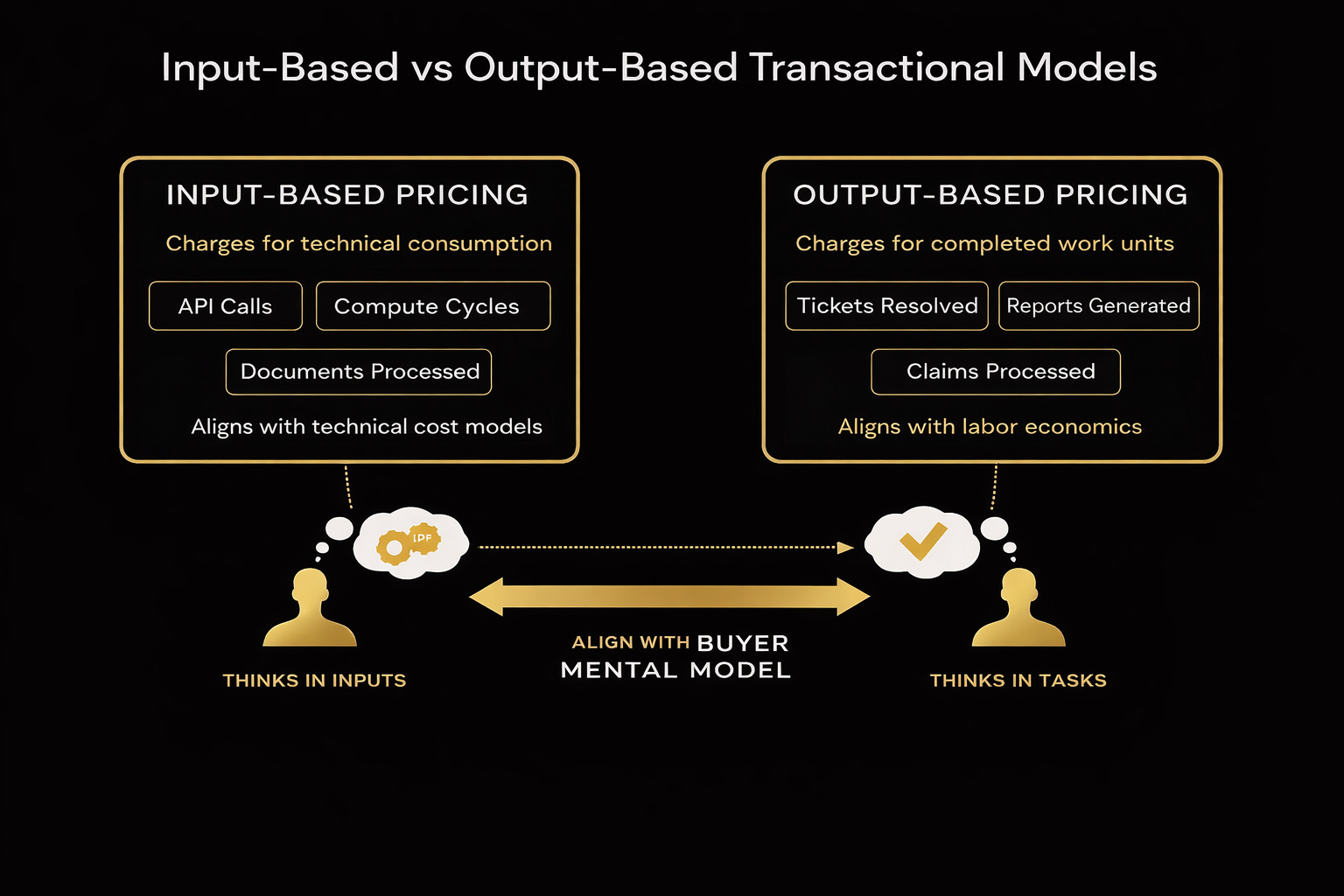
Input-based pricing charges for consumption: API calls, compute cycles, documents processed.
Output-based pricing charges for completed work units: tickets resolved, reports generated, claims processed.
When buyers think in tasks, pricing must reflect tasks.
Misalignment between buyer mental models and pricing units reduces adoption.
The Four Structural Pricing Variables
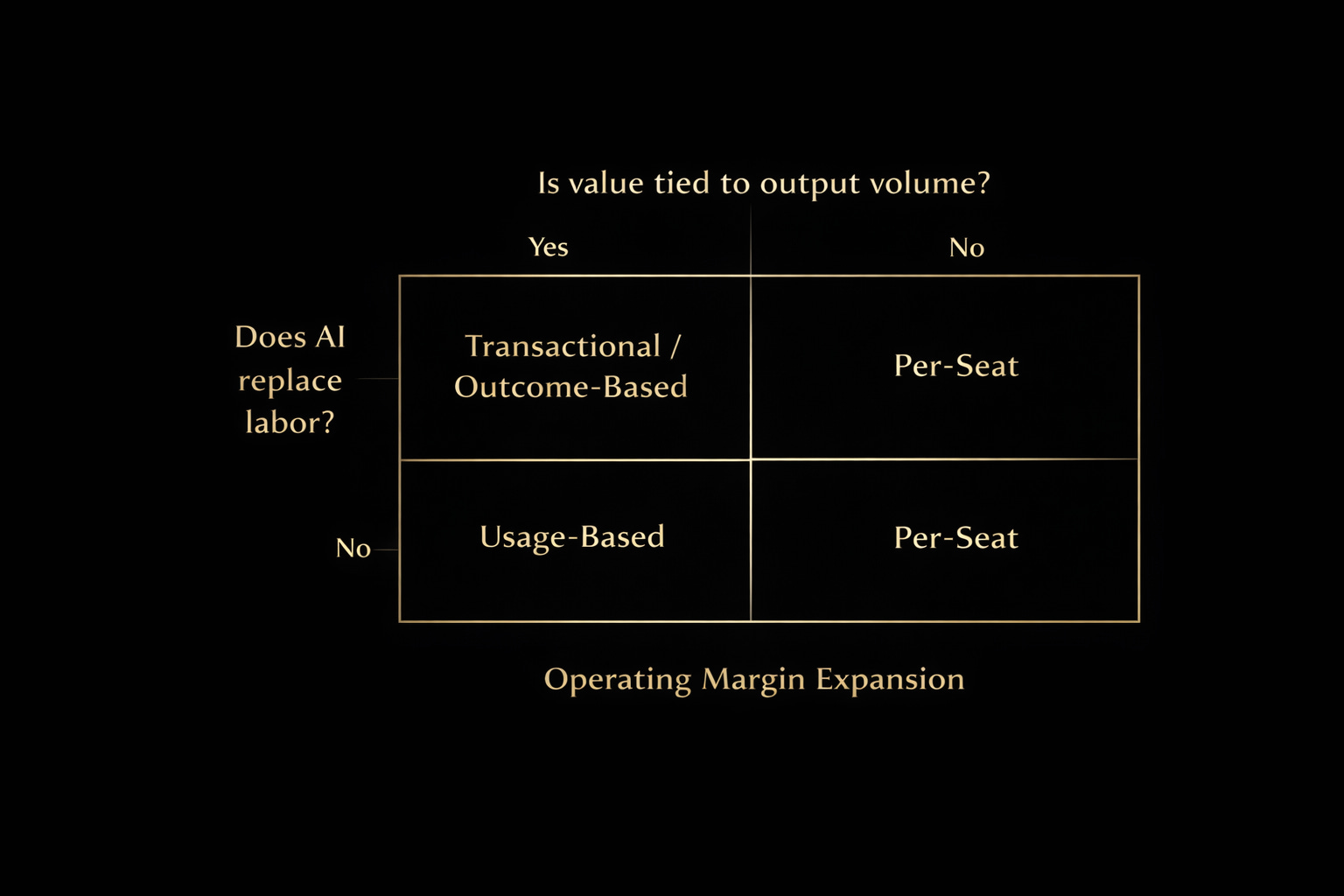
Before selecting a pricing architecture, founders must evaluate four structural variables.
Frequency of Usage
High-frequency tools introduce mental transaction costs under per-use billing. Fixed pricing often removes adoption friction in these cases.Magnitude of Cost Savings
If the product delivers substantial cost reduction relative to labor alternatives, transactional pricing may be economically justified.Workflow Integration Point
Tools inserted at the top of a workflow funnel capture predictable volume. Tools inserted selectively at later stages experience variable routing and revenue unpredictability.Budget Type
Selling into labor budgets supports transactional and output-based models. Selling into IT budgets may favor fixed subscription models.
These variables define the structural constraints of the pricing decision.
The Underpricing Illusion and False PMF Signals
Competing on price to gain initial traction introduces a subtle but dangerous distortion.
When customers adopt primarily due to lower pricing rather than differentiated value, early demand may create a false signal of product-market fit. As competitors adjust pricing or as the company attempts to raise prices, churn increases and perceived fit weakens.
Underpricing compresses margin and anchors market expectations. It also attracts price-sensitive customers who are less loyal and more likely to churn under competitive pressure.
If a product cannot win at comparable market pricing, the structural issue likely resides in value articulation or product differentiation, not in pricing level.
Institutional Anchor
Markets reward coherence between cost structure, value realization, buyer psychology, expansion logic, and go-to-market motion.
When pricing architecture aligns with these dimensions, revenue compounds with value, margin remains defensible, and expansion stabilizes.
When alignment breaks, growth exposes weakness. Revenue may rise while margin erodes, discounting increases, and forecasting destabilizes.
Foundational Law 02 is definitive:
Pricing is the architectural manifestation of how value expands inside the system.
It must reflect labor economics where labor is displaced.
It must balance predictability with elasticity.
It must align revenue capture with value realization.
Pricing determines whether growth compounds margin or compounds fragility.
Arithmetic is insufficient.
Architecture is required.
Doctrine Implications for Founders
Identify whether you are competing against software spend or labor spend.
Map the dimension in which customer value expands and price in that dimension.
Explicitly decide how much predictability you are willing to trade for elasticity.
Design hybrid structures deliberately rather than reactively.
Avoid price-led entry strategies that distort early product-market fit signals.
Re-evaluate pricing architecture as cost structures evolve with model improvements and infrastructure optimization.
Pricing is the only GTM lever that generates revenue. All others allocate it.
Design pricing with structural intent.