

The GTM Debug Framework
Sales is the output. Debug the system, not the symptom.

One of the founders I work with came to me recently, visibly frustrated.
“Am I just a bad salesperson?”
Revenue had plateaued. Deals were stuck in procurement. Conversion was weak. The blame had landed on the founder because they were the one selling.
This is one of the most common false diagnoses in go-to-market.
Sales is the last mile of a system. When it breaks down, the failure almost always originated upstream. Blaming sales is the equivalent of blaming the output for a problem in the input.
To fix the system, you have to trace the failure back to its source.
The Diagnostic Stack
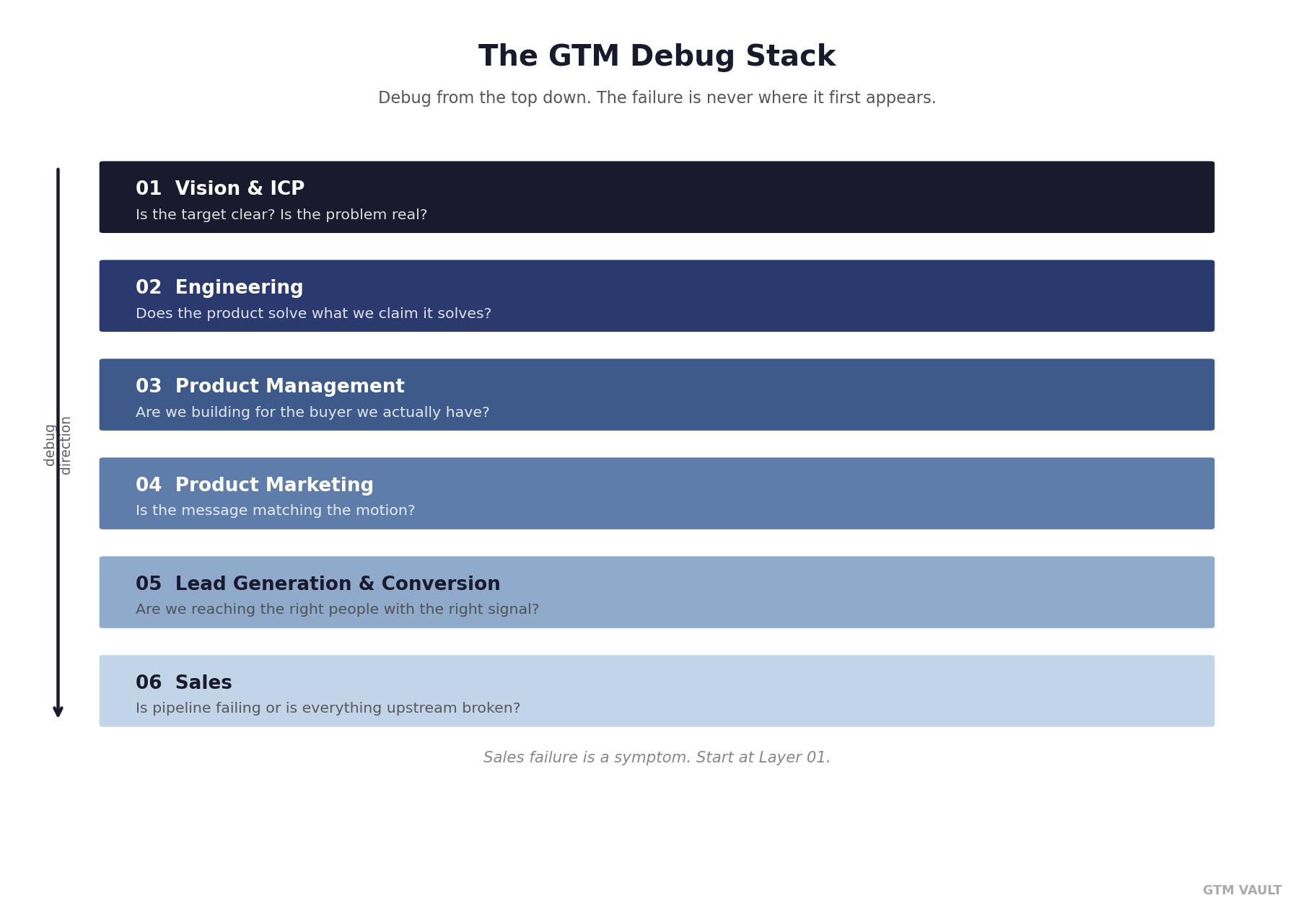
Longtime Sequoia partner Doug Leone describes what he calls the Merchandising Cycle — a sequenced diagnostic stack for tracing GTM failure from symptom to source:
Sales → Lead Generation and Conversion → Product Marketing → Product Management → Engineering → Vision
Start at Sales. Ask why it is not working. Then move upstream, one layer at a time, until you find the real break.
Most GTM diagnostics work in the wrong direction. They start at Vision, assume the strategy is sound, and then wonder why Sales is underperforming. The Leone framework reverses that. It starts where the pain is visible and follows the failure upstream to where it actually lives.
Layer 1: Vision
Are you solving a real problem for a buyer who cannot afford to leave it unsolved, in a market large enough to matter?
Misalignment at this layer produces wasted investment at every layer below it. The product gets built. The team gets hired. The campaigns get run. None of it compounds because the foundation was wrong.
The diagnostic question is not whether the founder believes in the vision. It is whether the buyer’s urgency is structural. A problem a buyer would like to solve is not the same as a problem they cannot afford not to solve.
If Vision is misaligned, no amount of sales execution or marketing spend will produce compounding growth.
Layer 2: Engineering
Is the product stable, reliable, and consistent at the scale your buyers operate?
A product that fails to perform reliably destroys trust faster than any positioning error. Buyers will accept a narrow product. They will not accept an unpredictable one.
If adoption is low despite a correct value proposition, check reliability before checking messaging.
Layer 3: Product Management
Are you building the right roadmap for the right buyer?
The failure pattern here is building features that demonstrate capability rather than features that solve the buyer’s structural constraint. A product roadmap that impresses analysts but does not reduce the buyer’s primary cost or risk will not convert.
The diagnostic question is whether the product team is building against a formally defined ICP or against the loudest voices in the support channel.
Layer 4: Product Marketing
Is the narrative clear, precise, and recognizable to the buyer you are targeting?
Buyers do not buy capability. They buy confidence that the problem will be solved. When product marketing is imprecise, buyers cannot self-qualify. Sales cycles lengthen because reps spend the first part of every conversation establishing why the problem matters rather than how the product solves it.
The diagnostic question is whether your buyer recognizes themselves in your positioning without needing a sales conversation to get there.
Layer 5: Lead Generation and Conversion
Are you generating demand from the right buyers at the right moment of urgency?
Volume is not the problem. Most GTM systems generate enough leads. The structural failure is targeting buyers who match the ICP profile but are not yet at the trigger condition that creates urgency. Pipeline fills. Conversion is slow and unpredictable.
The diagnostic question is whether your demand generation is built around trigger conditions or demographic fit.
Layer 6: Sales
Is the team equipped to convert qualified, urgent interest into closed revenue?
If every layer above is working correctly, Sales should close at a predictable rate. When Sales is the actual problem, the signals are specific: late-stage deal loss, procurement stalls with correctly profiled buyers, and win rates that vary significantly by rep.
When those signals are absent and revenue is still stalling, the failure is upstream. Sales is absorbing the blame for a system problem it did not create.
How to use this framework
Start at Sales. List every active failure: stuck deals, low conversion, slow cycles, high churn. Then ask what each failure would look like if the root cause were one layer upstream.
Work upward until you find the layer where the failure originates rather than where it surfaces.
Most revenue stalls trace back to Layers 1 through 4. By the time the problem is visible at Sales, it has been compounding for months at the layer that actually produced it.
The constraint is structural. The diagnosis has to match.
GTM Vault is a revenue architecture platform for B2B founders and operators. The Foundational Laws series establishes the architectural principles behind the GTM system. Start with Foundational Law 01: Premature Scaling Is Structural Failure.