The Org Chart Is Dead
How AI-native execution is replacing roles, teams, and GTM handoffs

For most B2B companies, the org chart has quietly become the most expensive piece of technical debt in the business.
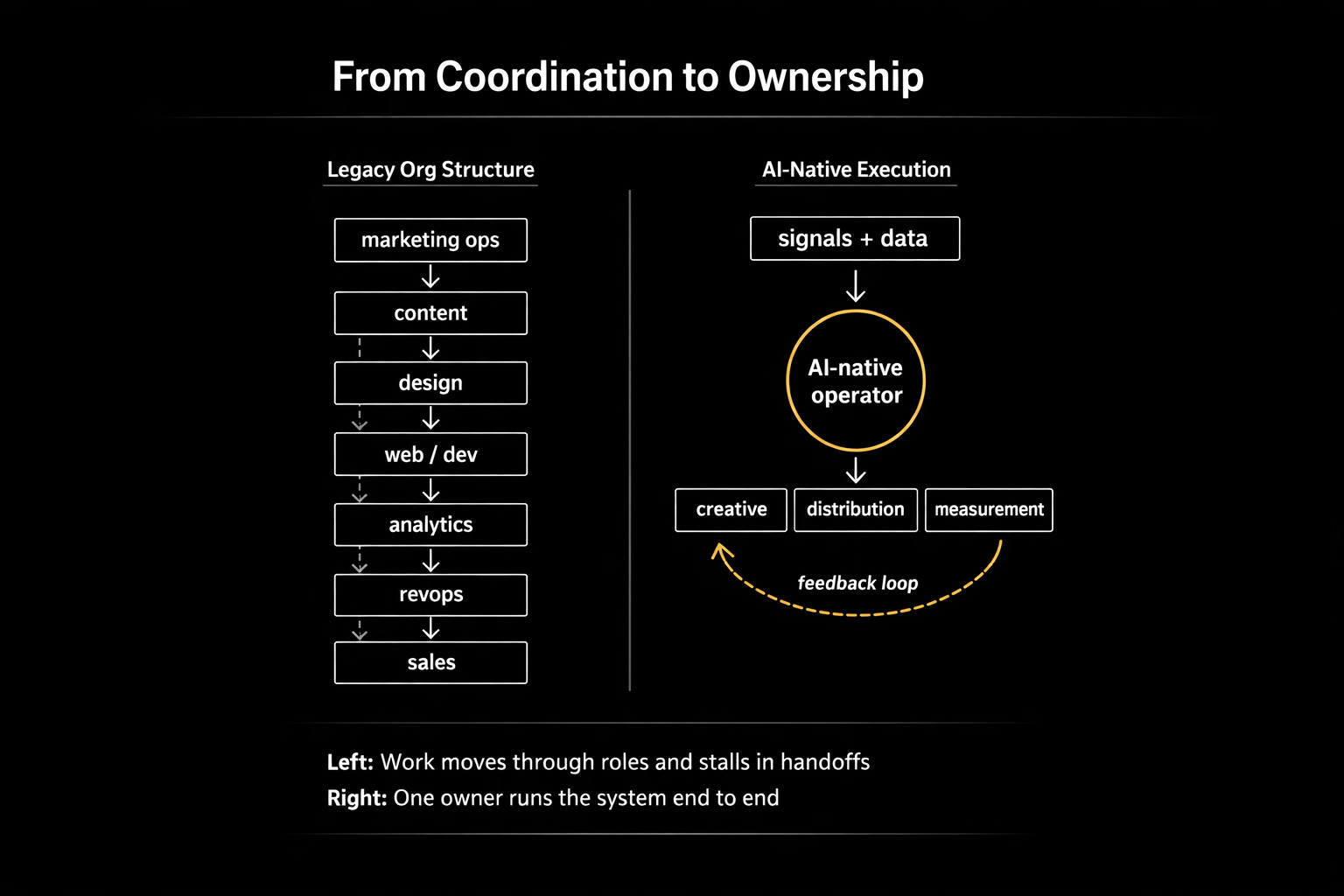
It was designed for a world where tools were hard to use, workflows were manual, and coordination was the only way to scale execution. That world no longer exists. AI has collapsed the cost of doing the work, but most teams are still organized as if work must move through roles, approvals, and handoffs instead of flowing through systems owned end to end.
The result is not just inefficiency. It is structural drag. Teams feel slower even as tooling improves. Headcount grows while output plateaus. Costs rise without a corresponding increase in learning velocity or revenue leverage.
After speaking with dozens of founders, CROs, and GTM leaders every month across SaaS, AI, and vertical software, the pattern is consistent. Teams are not failing because they lack talent. They are failing because responsibility is fragmented across functions that were optimized for outdated tooling constraints.
The problem is not headcount.
The problem is coordination.
Coordination Overhead Has Become the Dominant Cost
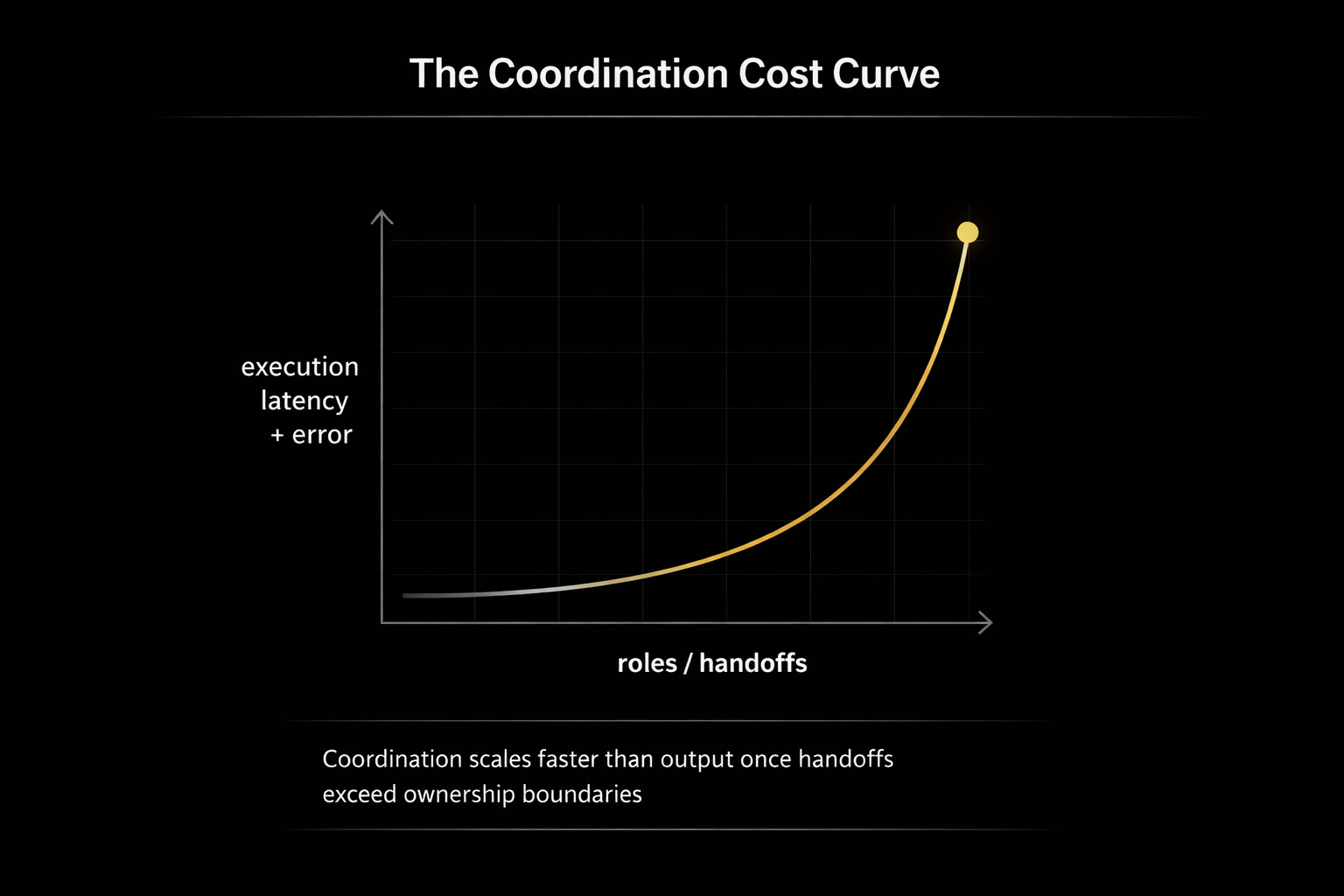
As organizations scale, communication paths grow exponentially, increasing latency, misalignment, and execution error even when individual contributors are strong. This has been well documented in organizational research for decades, but it was historically tolerated because specialization was unavoidable and automation was limited.
AI breaks that tradeoff.
Recent productivity research across knowledge work shows that when AI is embedded directly into execution workflows, individual output increases dramatically. However, those gains disappear when work is split across multiple roles, tools, and approval chains. In fragmented systems, AI accelerates noise instead of leverage.
AI does not fix broken org design.
It exposes it.
The highest-performing teams are not the ones adopting the most tools. They are the ones eliminating the most handoffs.
In practice, the difference is measurable. Across GTM teams we work with, moving from role-based execution to single-owner systems typically reduces cycle time by 40–70 percent for common workflows like campaign launches, outbound experiments, and content production, while holding quality constant or improving it. The gain does not come from working harder or faster. It comes from removing waiting, translation, and rework between steps.
From Role-Based Teams to End-to-End Ownership
The most important organizational shift underway is not downsizing. It is the replacement of role-based team design with end-to-end process ownership.
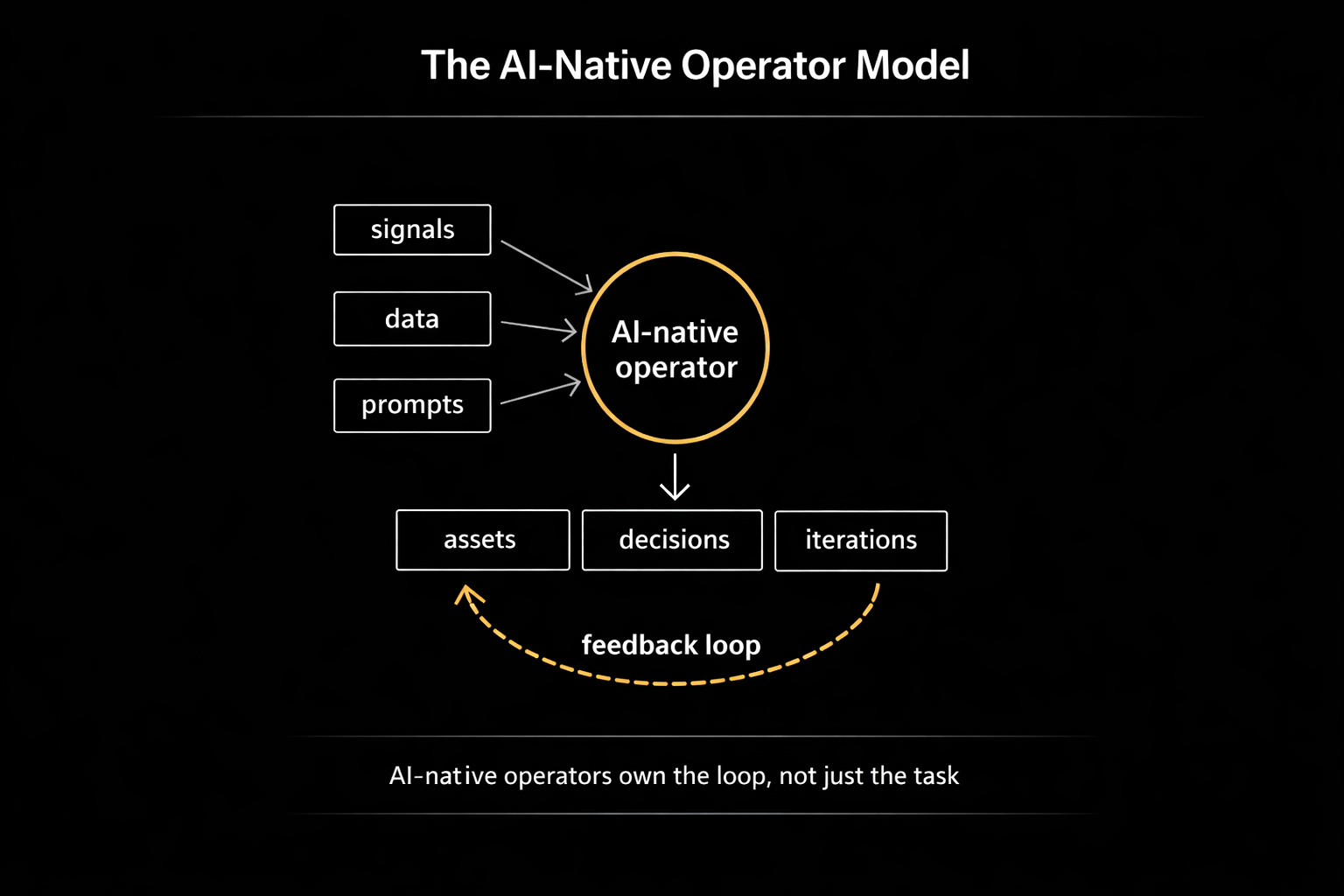
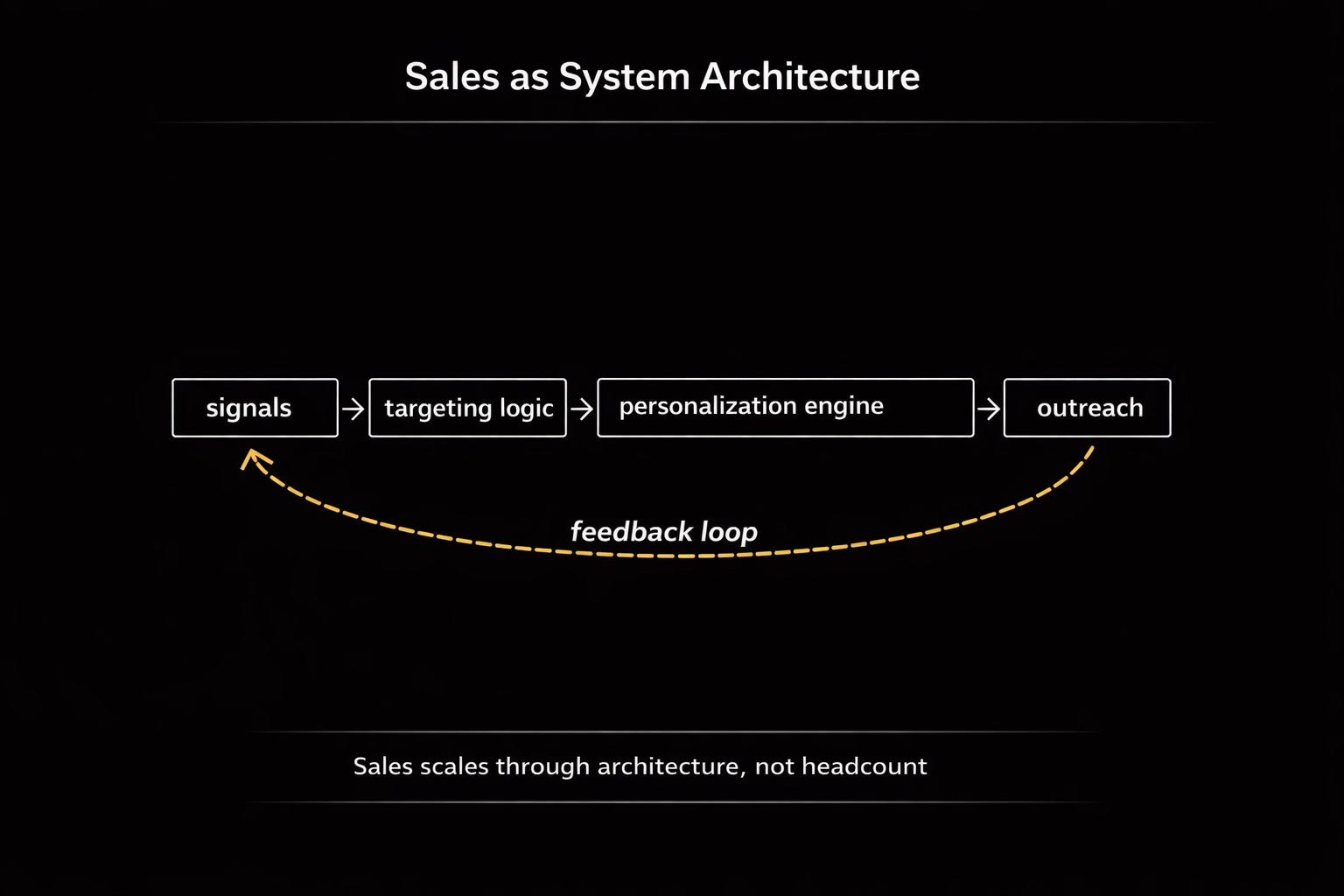
Instead of Marketing Ops, Content, Design, Web, and Analytics operating as separate functions, one AI-native operator owns the full campaign lifecycle, from concept to creative to distribution to iteration. Instead of SDRs, Sales Ops, and tooling specialists working in parallel, one GTM engineer designs and runs the outbound system itself, including signals, targeting logic, personalization rules, infrastructure, and feedback loops.
This is not a return to generalists.
It is the rise of AI-native operators.
These operators combine judgment, execution, and system design into a single accountable role. AI makes this possible by collapsing execution costs, not by removing the need for human decision-making.
The reduction in headcount is a consequence, not the goal.
The real gain is speed, clarity, and learning velocity.
Marketing Has Already Crossed the Line
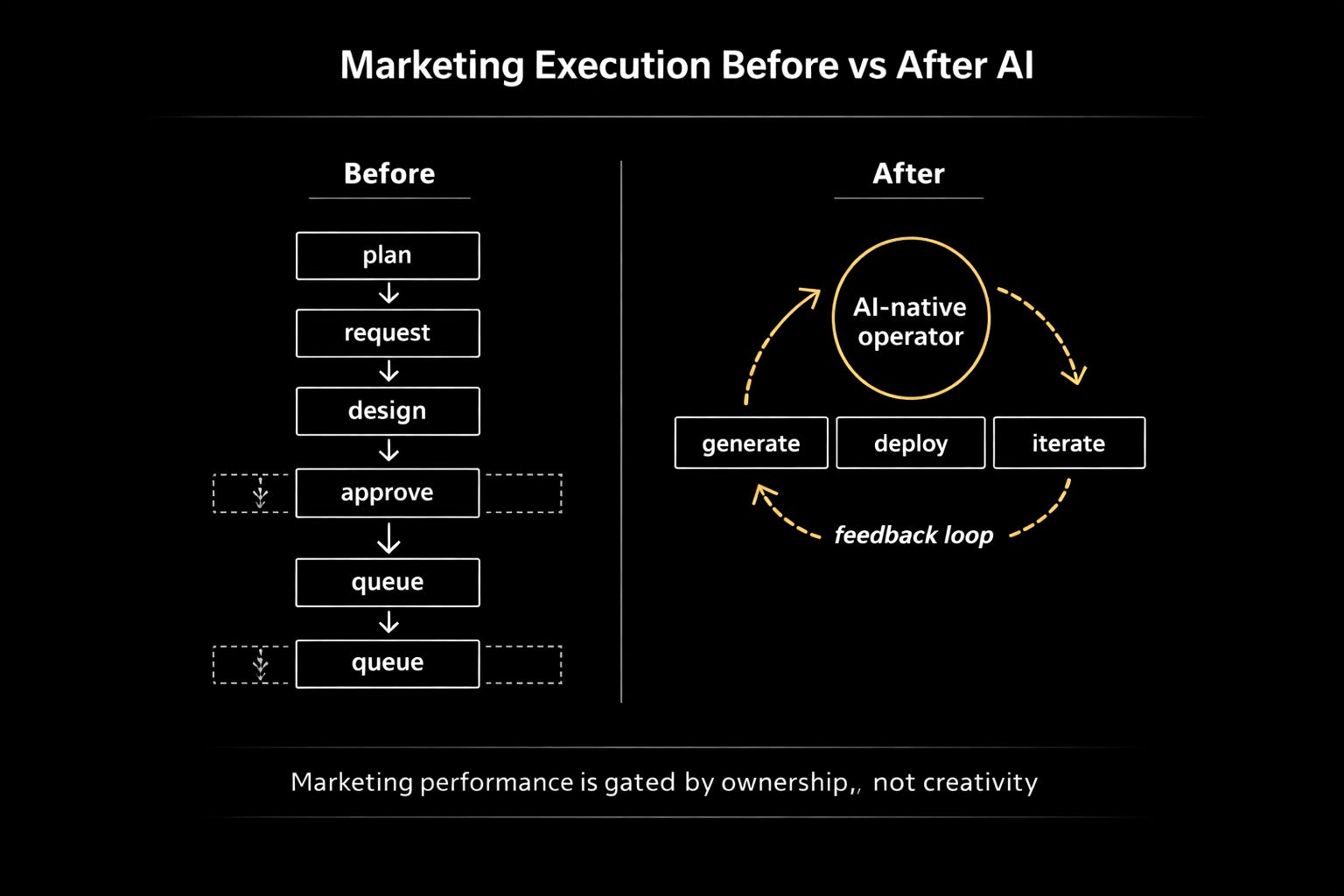
Marketing is the clearest example of this shift because it historically carried the highest coordination burden. Campaigns that should take days often took weeks due to internal queues, dependencies, and approval cycles.
AI-native tooling allows a single operator to generate assets, deploy landing pages, test messaging, distribute content, and iterate based on performance without waiting on internal teams. Companies that operate this way consistently ship more experiments per quarter and learn faster than competitors with larger marketing teams.
Research across experimentation-driven organizations shows a strong correlation between experimentation velocity and revenue growth. Teams that test more learn more, and teams that learn more compound advantage.
In this model, marketing performance is not constrained by creativity or budget.
It is constrained by ownership.
Content Is Now an Engineered System
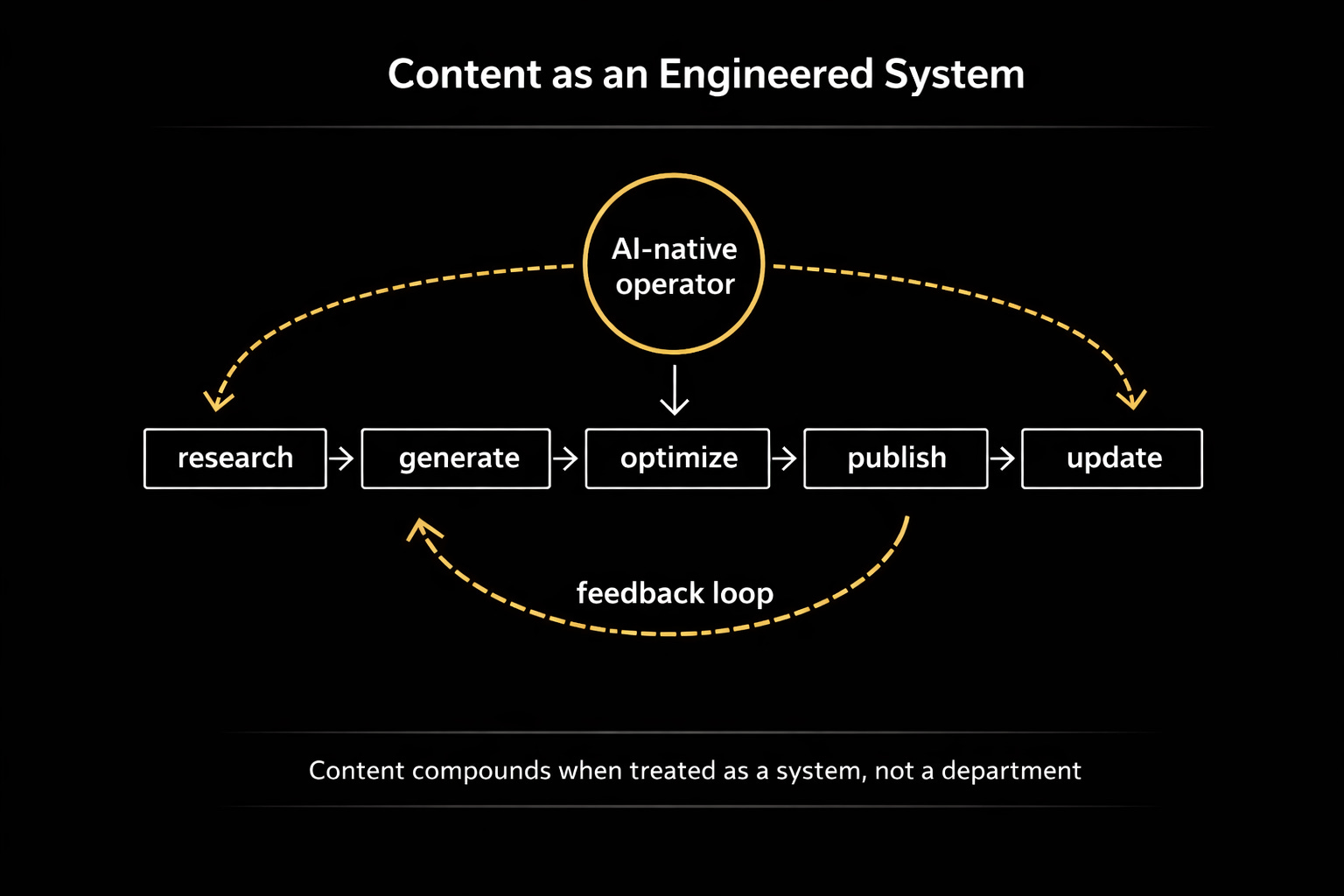
Content production used to scale linearly with headcount because research, writing, optimization, and publishing were disconnected workflows owned by different specialists. AI collapses these steps into a single programmable pipeline that one operator can supervise end to end.
This does not remove the need for taste or strategy. It centralizes it.
High-performing teams now treat content as an engineering system rather than a creative department, particularly in SEO-driven and product-led growth models where compounding effects matter more than one-off assets. The operator’s role is not to write content manually, but to design and govern a system that produces, updates, and improves content continuously.
The bottleneck was never writing speed.
It was workflow fragmentation.
Sales Has Shifted From Activity to Architecture
Traditional sales organizations optimized for activity because targeting was imprecise and personalization was expensive. AI reverses that constraint by making signal detection and personalization cheap while making volume-based outreach increasingly ineffective.
Modern outbound performance is driven by system architecture, not headcount. Signal-based prospecting consistently outperforms spray-and-pray approaches on both conversion rates and CAC efficiency. The most effective sales motions are designed by a small number of GTM engineers who understand data flows, buyer behavior, and execution infrastructure.
Sales is no longer a people-scaling problem.
It is a systems-design problem.
RevOps, Ops, and Product Follow the Same Law
Across RevOps, internal operations, and product development, the same structural pattern repeats. Teams built to manage complexity become the source of it once tooling constraints disappear.
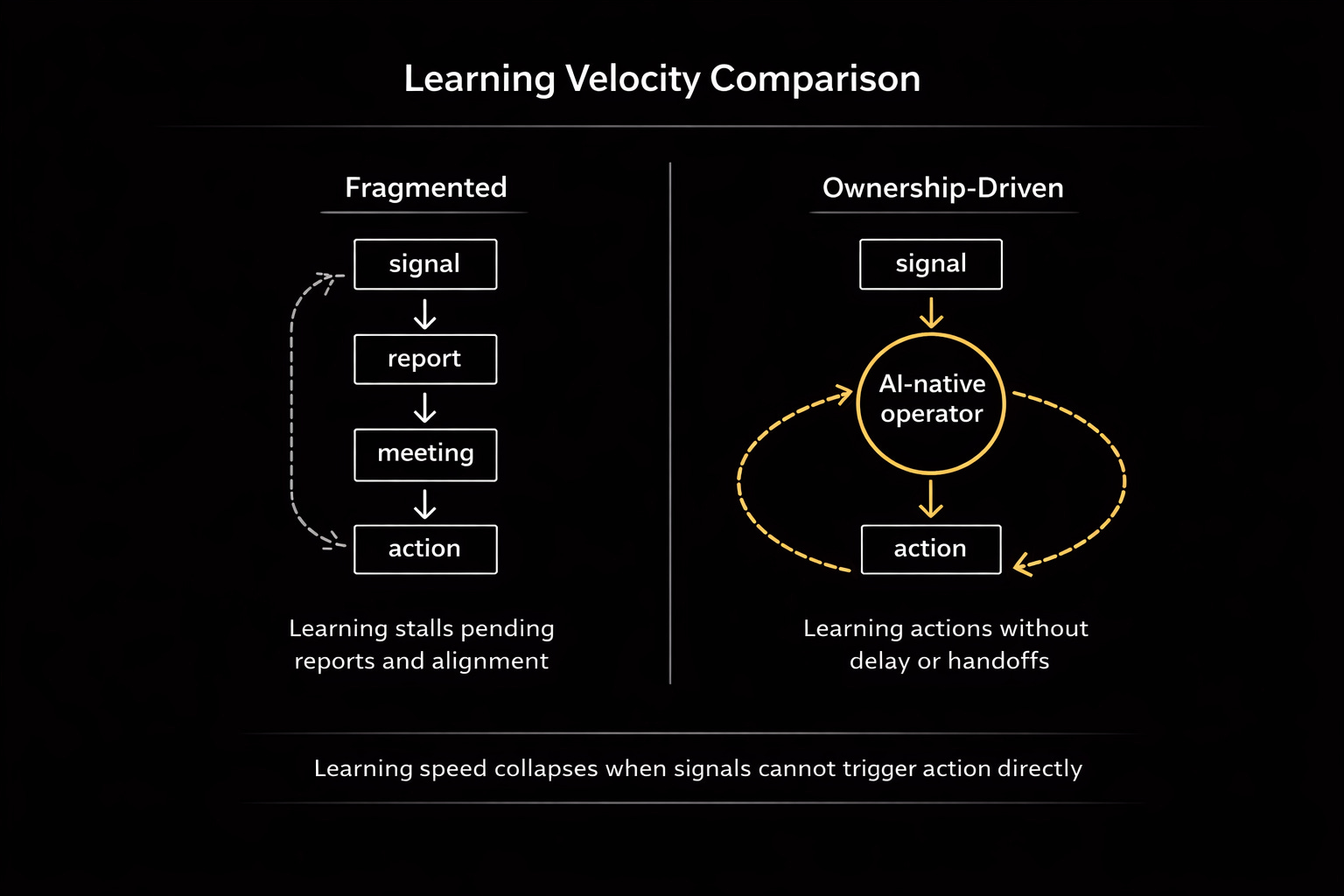
When the same operator who observes a signal can change the system immediately, learning cycles compress dramatically. When responsibility is fragmented, insights stall in dashboards, meetings, and alignment rituals.
AI-native organizations replace coordination with ownership and reporting layers with execution intelligence embedded directly into workflows.
The Economic Reality Most Teams Avoid Naming
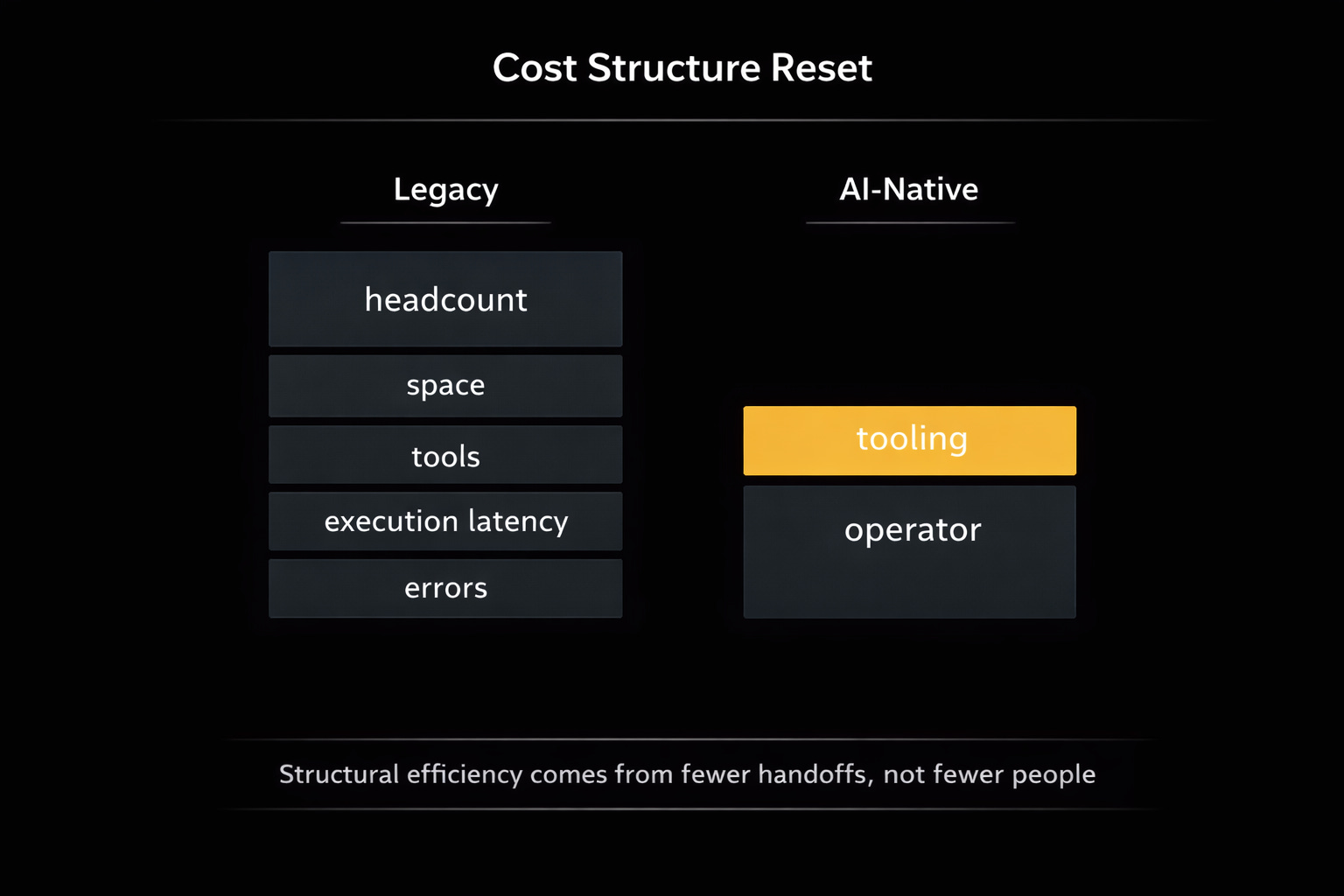
When companies redesign around end-to-end ownership enabled by AI-native execution, the outcomes are consistent across stages:
Headcount compresses without reducing output
Fixed costs fall faster than revenue
Speed increases without proportional increases in risk
This is not cost cutting.
It is structural efficiency.
The companies pulling ahead are not hiring faster or raising more capital. They are designing organizations with fewer failure points and tighter feedback loops.
GTM Engineering Is Now Org Design
GTM is no longer a collection of functions that need better alignment meetings. It is an engineered system that lives or dies by ownership.
The companies that win the next decade will not look impressive because they have large teams or complex stacks. They will look fast, quiet, and oddly small for the output they generate.
AI did not eliminate the need for people. It eliminated the tolerance for fragmented responsibility.
If your org chart still optimizes for coordination instead of ownership, it is not neutral. It is actively working against your speed, your margins, and your ability to learn.
That is what GTM engineering means now.