The AI-Native Revenue Engine
Why Information Architecture, Not Execution Speed, Will Define Modern GTM

Executive Summary
Artificial intelligence is not fundamentally transforming go-to-market because it drafts emails faster, generates content more efficiently, or automates surface-level workflows. It is transforming go-to-market because it alters how information moves across the revenue organization, and in doing so, reshapes the structural foundations upon which modern GTM systems are built.
Most organizations are applying AI at the surface layer of execution, optimizing for task-level productivity improvements within existing silos while leaving the underlying coordination architecture unchanged, and in doing so, mistaking acceleration for transformation. These gains are tangible and often measurable in the short term, but productivity improvements alone do not produce durable competitive advantage because speed without structural integration merely amplifies fragmentation.
The organizations that will meaningfully outperform are not those that adopt AI fastest, but those that redesign their information architecture around it. AI applied to tasks improves speed. AI embedded into coordination eliminates friction. Only one of those compounds. When intelligence is embedded into architecture rather than confined to individuals, the organization transitions from fragmented execution to adaptive orchestration.
That transition is not incremental. It is structural. And structural shifts compound.
I. The Critical Distinction: Augmentation Versus Integration
AI adoption across sales and marketing has already reached a meaningful threshold. Industry research consistently shows that the majority of B2B organizations are experimenting with or actively deploying AI across various revenue functions, and many are reporting improvements in productivity, campaign velocity, and administrative efficiency.
Yet widespread adoption does not equate to structural transformation.
In what can be described as augmentation mode, AI improves the performance of discrete tasks within existing silos. Marketing teams generate content more quickly. Sales teams automate personalization at scale. Customer success teams summarize interactions without manual transcription. Each function becomes more efficient within its own boundaries.
However, the boundaries remain intact.
Insights uncovered during sales conversations rarely propagate automatically to product marketing positioning. Content performance data does not dynamically recalibrate outbound targeting logic. Competitive intelligence updates do not cascade seamlessly across narrative frameworks without deliberate coordination.
Execution accelerates, but coordination remains manual.
AI-native GTM begins only when intelligence is embedded into the system that connects functions, rather than confined within them.
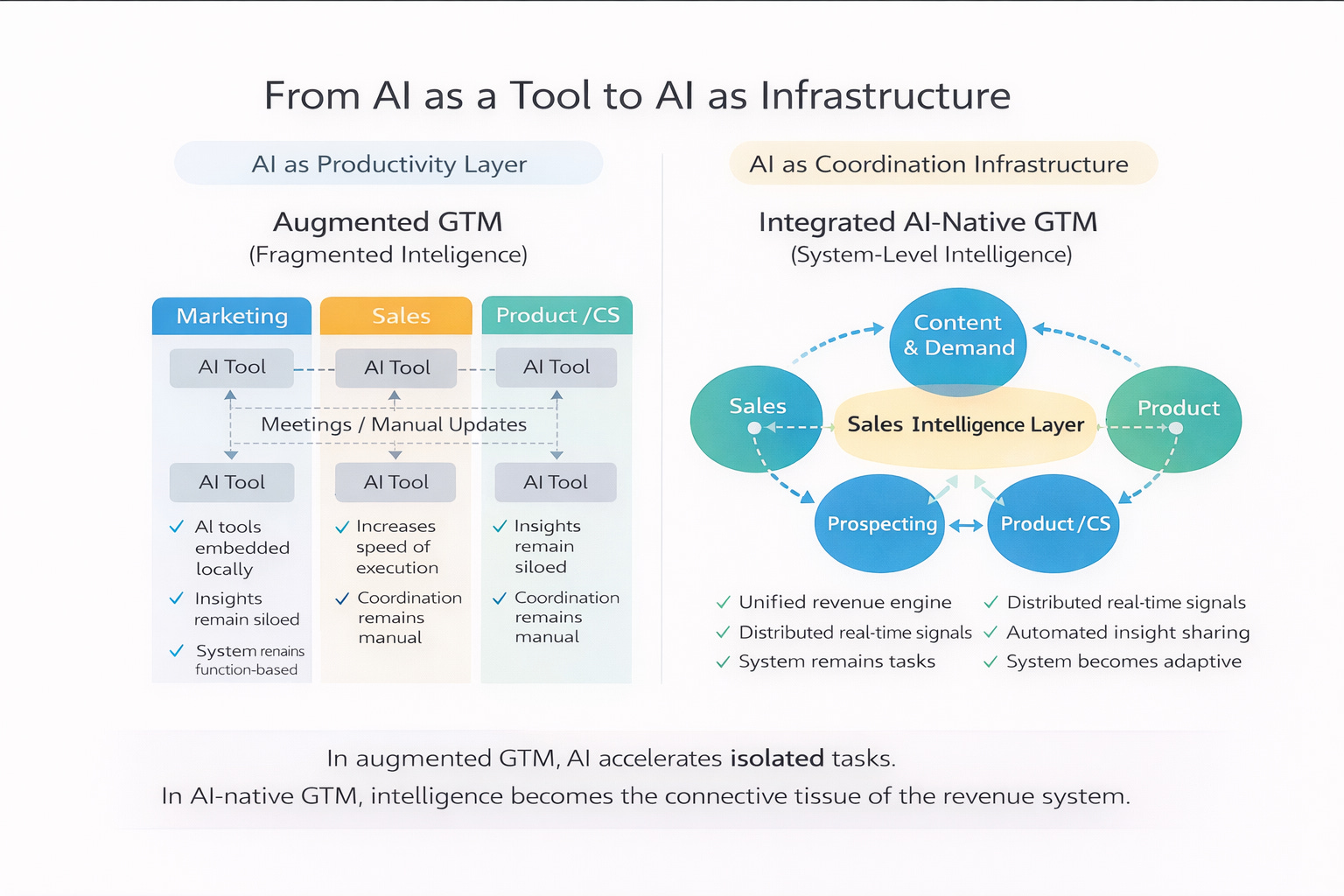
In an integrated model, insights do not wait for meetings. Signals do not stall at departmental borders. Messaging recalibrates continuously based on live data flows rather than periodic strategic reviews. Feedback loops compress structurally, not just operationally.
The result is not faster activity, but higher organizational metabolism.
II. Content as Knowledge Architecture Rather Than Marketing Output
For decades, content marketing has operated primarily as an output discipline, where success was measured by volume, traffic, engagement, and ranking performance. Campaigns were designed around discrete assets, and SEO strategies were optimized for keywords rather than coherence.
AI enables a fundamentally different approach.
When organizations begin structuring their content ecosystem as a knowledge architecture rather than a publishing calendar, they unlock compounding visibility across both human and machine-mediated discovery channels. Instead of isolated blog posts or gated assets, they build interconnected topic networks aligned precisely to ICP pain points, decision-stage questions, and objection language extracted from real sales interactions.
Webinar transcripts, customer conversations, product documentation, and win-loss data can feed into continuously evolving repositories that function not merely as marketing assets but as structured intelligence infrastructure. In an environment increasingly influenced by AI-powered research tools and answer engines, machine-readable coherence becomes as important as narrative quality.
Speed of production may drive short-term engagement.
Structural clarity drives long-term dominance.
Organizations that treat content as infrastructure rather than collateral will accumulate visibility advantages that competitors cannot easily replicate, because infrastructure compounds while campaigns decay.
In AI-mediated markets, content is no longer a marketing output. It is indexing infrastructure for machines that influence buying decisions before sales ever enters the conversation.
The companies that treat content as a campaign will rent attention. The companies that treat it as knowledge architecture will own discovery.
III. Continuous Market Intelligence and the End of Periodic Positioning
Traditional product marketing evolved around periodic research cycles. Personas were refined annually, competitive analyses updated quarterly, and messaging frameworks revisited during major product launches. This cadence reflected a market environment in which change occurred at a manageable pace and differentiation remained relatively stable over time.
That assumption no longer holds.
AI enables revenue teams to operate on a model of continuous market intelligence, where CRM notes, call transcripts, behavioral engagement data, social signals, and pipeline patterns are analyzed in near real time. Objection clusters can be identified across hundreds of conversations simultaneously. Emerging competitor narratives can be detected before they gain momentum. Subtle shifts in buyer language can surface weeks before they appear in formal research.
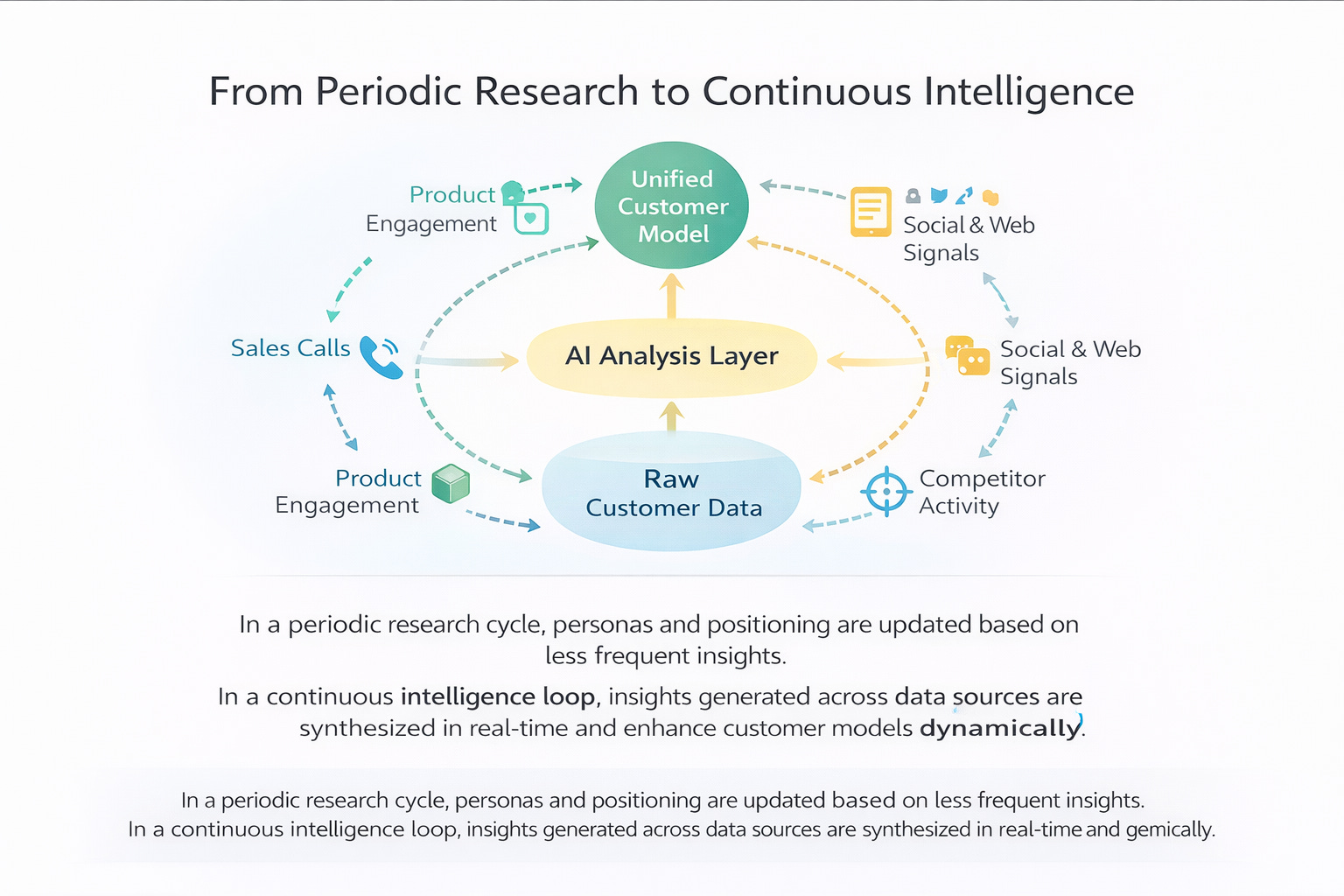
The strategic benefit is not simply better insight.
It is reduced latency between insight and execution.
When messaging adapts continuously instead of episodically, narrative drift is minimized. When positioning updates dynamically rather than reactively, brand coherence strengthens. Over time, the organization develops an adaptive learning loop that reduces strategic misalignment and increases signal precision.
In AI-native GTM, intelligence is not gathered periodically.
It flows persistently.
Revenue latency is no longer a market constraint. It is a design decision. Organizations that still operate on quarterly insight cycles are choosing delay in a system that can now learn daily.
In AI-native GTM, the question is no longer whether you understand your buyer. It is how quickly your system updates when your buyer changes.
IV. Signal Architecture Replaces Volume Arithmetic
Outbound prospecting has historically relied on probabilistic math, where sufficient volume compensates for imperfect targeting. More emails, more calls, and more touches statistically increased the likelihood of pipeline generation.
AI fundamentally reshapes this model by enabling signal aggregation across diverse behavioral inputs.
Website interactions, content engagement patterns, hiring activity, funding announcements, technology stack changes, and product usage signals can be synthesized into dynamic prioritization models that identify not just who fits the ICP, but when that ICP is most receptive.
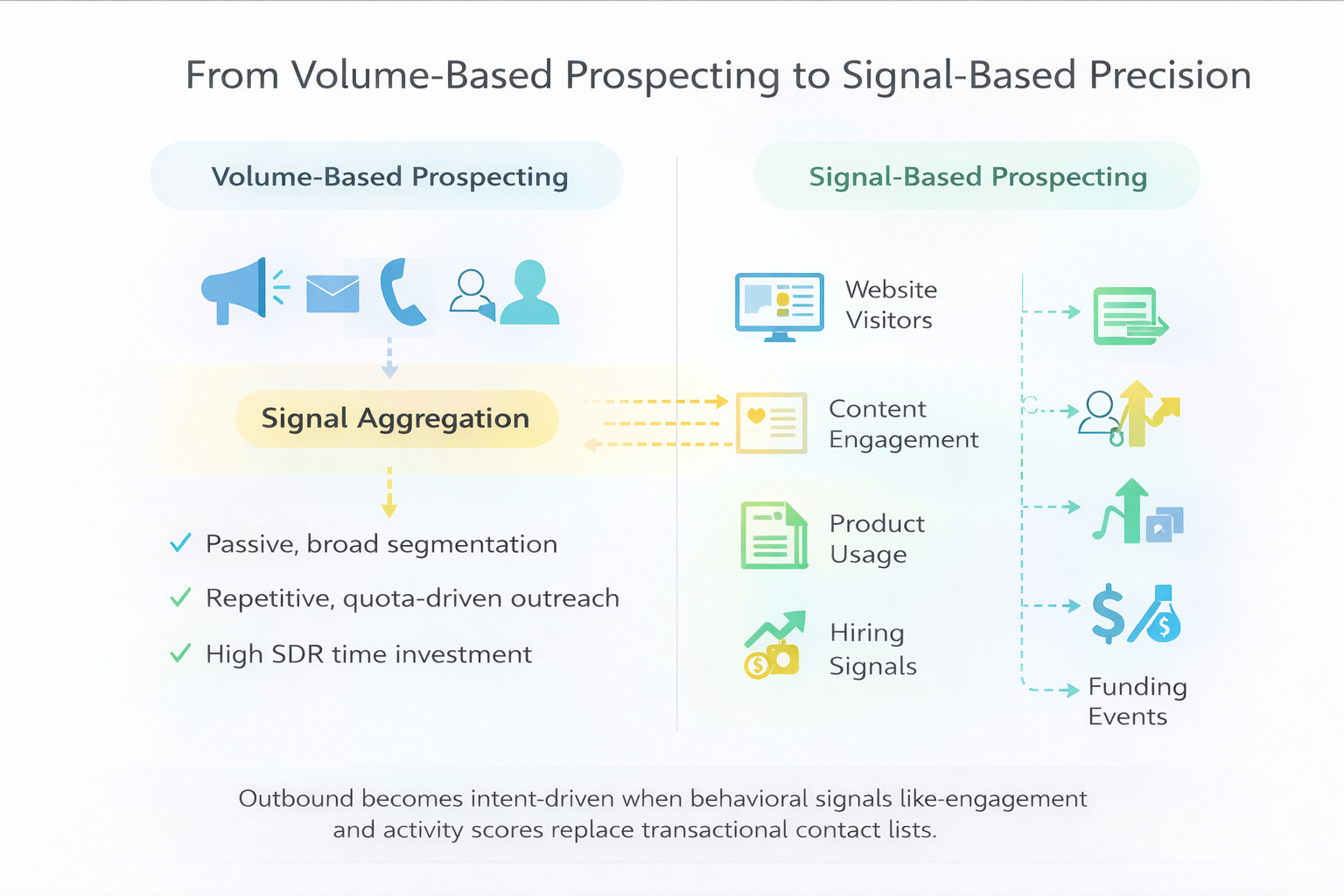
The performance advantage does not stem from personalization alone.
It emerges from synchronization.
When outreach aligns precisely with contextual relevance and intent signals, response probability increases disproportionately relative to effort. As a result, smaller teams operating with high-fidelity signal infrastructure frequently outperform larger teams operating on static segmentation.
Pipeline is not generated by activity. It is engineered by synchronization between signal and timing.
Signal systems outperform volume systems because they operate on timing rather than probability. Volume arithmetic eventually saturates as inboxes fill and attention compresses. Signal synchronization compounds because it aligns outreach with context and readiness.
This is not simply a personalization upgrade layered onto outbound. It is a re-engineering of how pipeline is constructed, shifting from statistical exhaustion to behavioral precision.
V. Sales as a System-Level Intelligence Generator
Sales conversations represent one of the richest sources of market intelligence available to any B2B organization. Each demo, discovery call, and objection sequence contains insights about pricing sensitivity, integration concerns, competitive positioning, and emotional decision drivers.
Historically, much of this intelligence has been fragmented, captured inconsistently in CRM notes, and rarely synthesized at scale.
AI enables systematic extraction.
Call recordings can be categorized across objection types, competitor mentions, and sentiment patterns. Closed-lost deals can be classified by root cause, enabling targeted messaging refinement. Re-engagement workflows can activate when external triggers, such as leadership changes or funding events, create renewed opportunity.
Sales is no longer the end of the funnel. It is the primary sensor network of the revenue system.
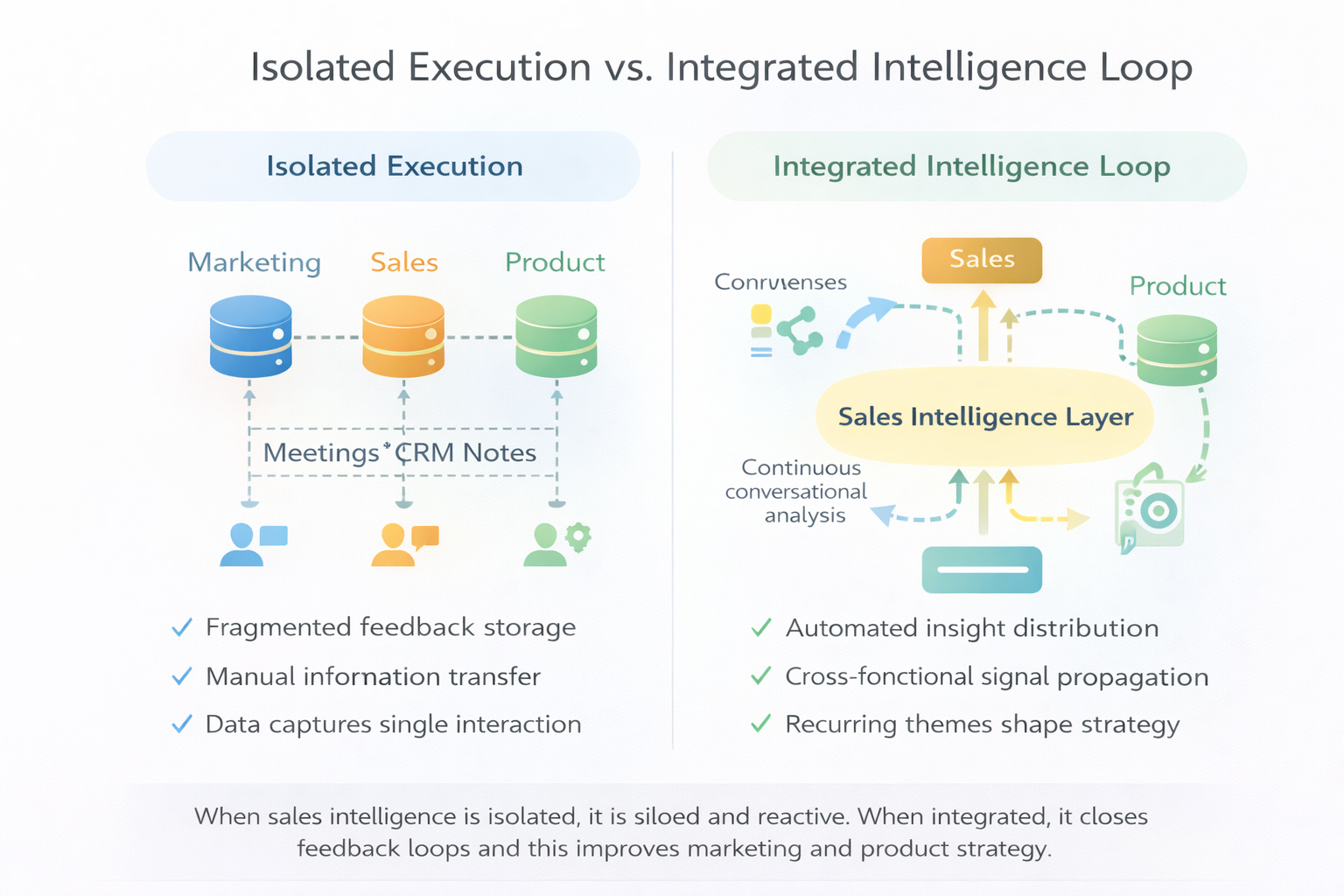
When sales transitions from a terminal execution function to a core intelligence engine, the entire revenue architecture sharpens. Marketing narratives align more tightly with real buyer concerns. Product teams receive live demand feedback. Prospecting sequences evolve in response to observed friction rather than assumed positioning.
The organization becomes progressively self-correcting.
VI. The Hidden Tax: Coordination Drag
As revenue organizations scale, a largely invisible force begins to compound against them. Marketing produces more assets, sales runs more sequences, product ships more features, and leadership schedules more alignment meetings. Output increases. So does friction.
I call this coordination drag.
In a mid-market SaaS organization operating at approximately $20M in ARR, coordination drag rarely appears as visible failure; it appears as subtle latency. Marketing refines positioning after campaign data reveals narrative friction, while sales continues executing sequences built on last quarter’s messaging because the update has not yet propagated through enablement systems and CRM logic. Product receives recurring objections about integration complexity, but that signal surfaces weeks later in roadmap discussions. Nothing is broken. Yet learning does not compound. It stalls between departments.
Coordination drag is the cumulative cost imposed by manual insight transfer across marketing, sales, product, and customer success. It is the time spent reconciling data between systems, reinterpreting insights across functions, and re-explaining context in recurring meetings. As teams grow, this drag compounds nonlinearly.
If your marketing team learns something on Monday and your sales team acts on it three weeks later, you do not have a talent problem. You have coordination drag.
Most companies misdiagnose the slowdown as a performance issue. In reality, it is an architectural one.
AI-native GTM reduces coordination drag by embedding alignment into infrastructure. When intelligence automatically propagates across CRM systems, content repositories, campaign engines, and analytics layers, alignment occurs through system design rather than meeting cadence.
The human role shifts from transferring information to interpreting it.
That shift is where structural leverage lives.
Companies that compress coordination drag scale cleanly.
Companies that ignore it stall at complexity thresholds.
Over time, coordination drag becomes the silent variable separating high-growth revenue engines from organizations that plateau under their own internal friction.
VII. The Strategic Fork Ahead
AI adoption will not meaningfully differentiate companies in the near future, because within a relatively short period of time, nearly every revenue team will deploy generative tools, automate administrative workflows, and accelerate surface-level execution across marketing and sales functions.
Augmentation will become baseline.
Integration will become advantage.
Execution speed will normalize across competitors as access to tools commoditizes and productivity improvements flatten into industry standards. What will not normalize, even as tooling commoditizes and execution speed converges across competitors, is the structural quality of information flow inside the revenue system. Organizations that remain dependent on manual coordination, episodic insight transfer, and meeting-driven alignment will experience rising coordination drag as they scale. Meetings will multiply. Narrative drift will widen. Internal friction will compound faster than revenue growth.
The organizations that embed intelligence into their infrastructure now will experience the opposite dynamic. Each interaction will inform the next in a continuous loop. Each signal will refine targeting with greater precision. Each objection surfaced in a sales conversation will sharpen positioning across the entire system. Learning will compound structurally rather than occurring in isolated bursts.
AI-native GTM is not a feature upgrade layered onto existing processes. It is a structural redesign of how revenue systems think, adapt, and coordinate under conditions of increasing complexity and speed.
The companies that fail to reduce coordination drag will not lose because their teams lack talent, ambition, or effort. They will lose because their architecture compounds friction faster than it compounds intelligence, and friction eventually overwhelms even strong execution.
The window to build adaptive revenue infrastructure is open, but architectural advantages will harden quickly as integration becomes widespread.
In competitive markets, execution can be replicated.
Architecture cannot.
The companies that fail to redesign their information architecture will not collapse dramatically; they will simply grow more complex, more meeting-dependent, and more coordination-heavy over time, until friction compounds quietly enough to flatten what once looked like momentum.
Architecture decides.