

Pricing Restructures Every Layer It Touches
GTM Architecture Laws


Executive Summary
Pricing in the AI era is no longer a subscription packaging decision. It is a structural alignment problem between cost exposure, value realization, and budget capture.
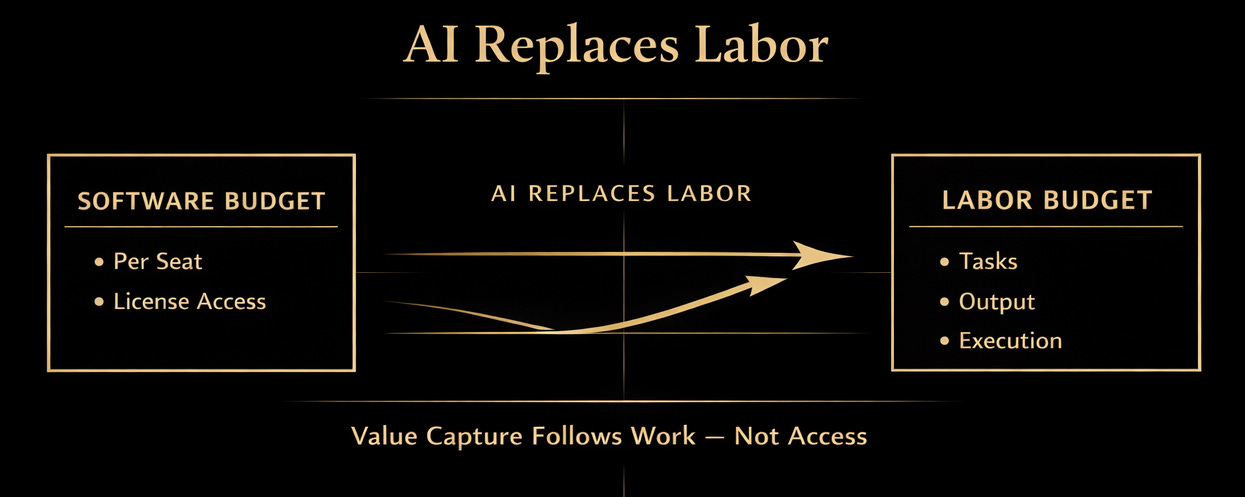
For example, if your AI replaces three analysts but you price per seat, your revenue no longer scales with the value you create. You are displacing labor economics while capturing software economics. The mismatch compounds as adoption grows.
AI-first companies increasingly compete against fully loaded labor costs, not just other software vendors. This shift changes pricing logic. Seat-based models optimize predictability but often undercapture value when automation replaces human effort. Transactional models capture value more directly but introduce volatility. Hybrid architectures anchor predictability while enabling elastic expansion.
This law establishes five structural truths:
Pricing must mirror the dimension in which value expands.
AI shifts competition from software budgets toward labor budgets.
Predictability supports valuation. Elasticity supports value capture.
Hybrid architectures reconcile margin st›ability with economic efficiency.
Misalignment distorts product-market fit signals.
Organizations that treat pricing as architecture design durable economic systems. Organizations that treat pricing as arithmetic amplify fragility at scale.
The broader system-level framing of pricing as a go-to-market architecture decision is developed in Episode 37: Pricing Is the GTM System.
The Structural Failure Pattern
A recurring pattern is emerging across AI-native companies.
The company adopts a pricing model inherited from traditional SaaS. Early traction validates the product. Usage scales unevenly. A small percentage of customers drive disproportionate compute costs. Sales begins discounting to close deals in response to procurement resistance. Revenue grows, but margin compresses. Forecasting becomes less reliable. Expansion becomes negotiation-heavy.
AI removes the margin buffer traditional SaaS relied on. When value replaces labor instead of licenses and cost exposure becomes variable, pricing must adjust or margin erodes as revenue grows.
Keep reading with a 7-day free trial
Subscribe to GTM Vault to keep reading this post and get 7 days of free access to the full post archives.