

Agentic GTM Requires Systems, Not Smarter Agents
Why AI-first go-to-market only works when context, orchestration, and execution are designed together

TL;DR
Agentic GTM does not fail because agents are immature. It fails because most go-to-market systems are fragmented, misaligned, and held together by manual work. When AI agents are added on top, they don’t create leverage - they automate those weaknesses at scale. Agentic GTM only works when teams first unify account-level context, make orchestration explicit across marketing, sales, and product, and give humans a clear control surface for when judgment matters. The advantage doesn’t come from smarter agents. It comes from systems that are designed to support them.
The Misunderstanding at the Center of Agentic GTM
Most B2B teams exploring agentic GTM assume the breakthrough comes from the agent itself - better prompts, more autonomy, or more human-like reasoning layered on top of existing workflows.
In practice, that assumption is exactly why agentic GTM breaks in production.
Agents do not create leverage on their own. They simply act on top of the systems that already exist across sales, marketing, product, and RevOps. When those systems are fragmented, slow, or misaligned, agents do not fix the problem. They execute it faster and at scale.
What feels like AI noise is usually system debt being automated.
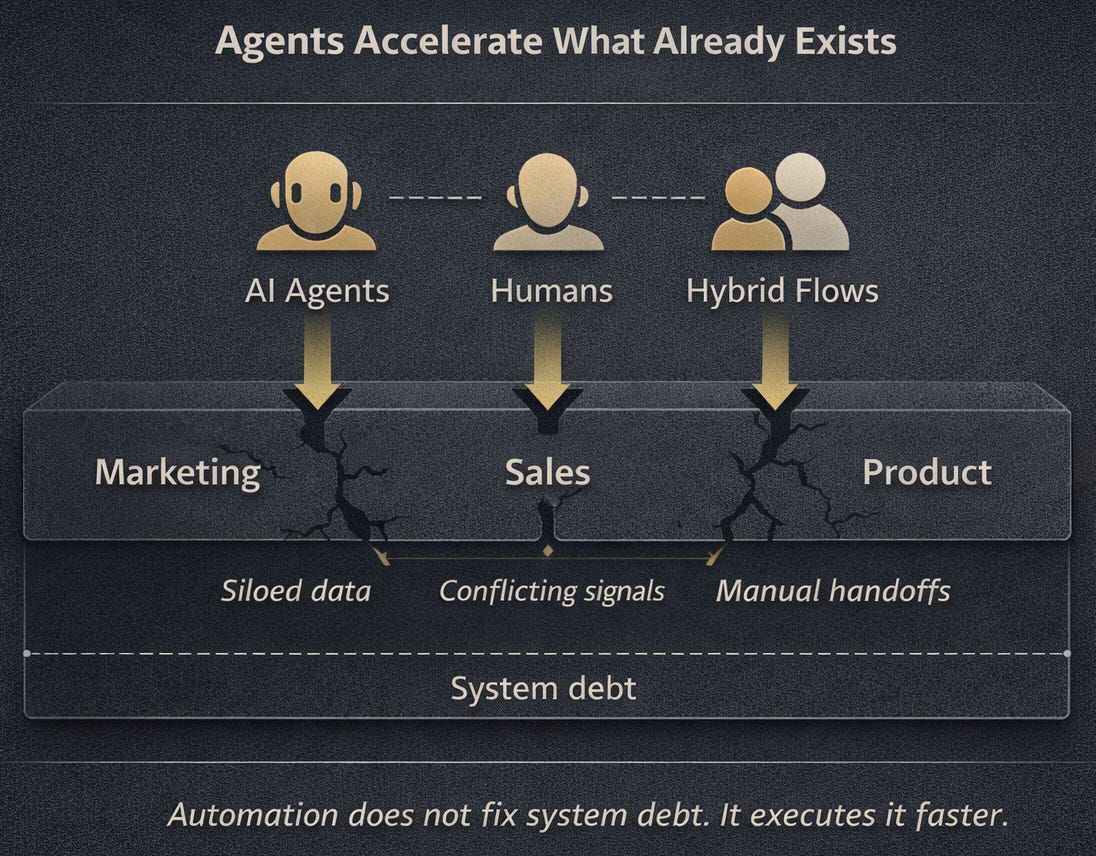
Why Automation Becomes Dangerous in an Agentic World
In traditional GTM, weak data quality and misalignment created inefficiency. SDRs chased the wrong accounts. AEs worked deals that never should have existed. Marketing optimized for signals that did not translate into revenue.
Those failures were expensive, but human throughput kept them contained.
In an agentic environment, the same weaknesses become far more damaging. Agents act continuously, confidently, and without hesitation, making decisions based on partial or stale context. Errors compound before humans notice. By the time teams react, the damage has already propagated across channels.
This is why many agentic GTM experiments feel busy but ineffective. The problem is not the agents. It is the foundation they are running on.
The Three Systems Agentic GTM Requires Before Agents Are Deployed
Agentic GTM only works when three underlying systems are intentionally designed first. Without them, agents amplify chaos rather than clarity.
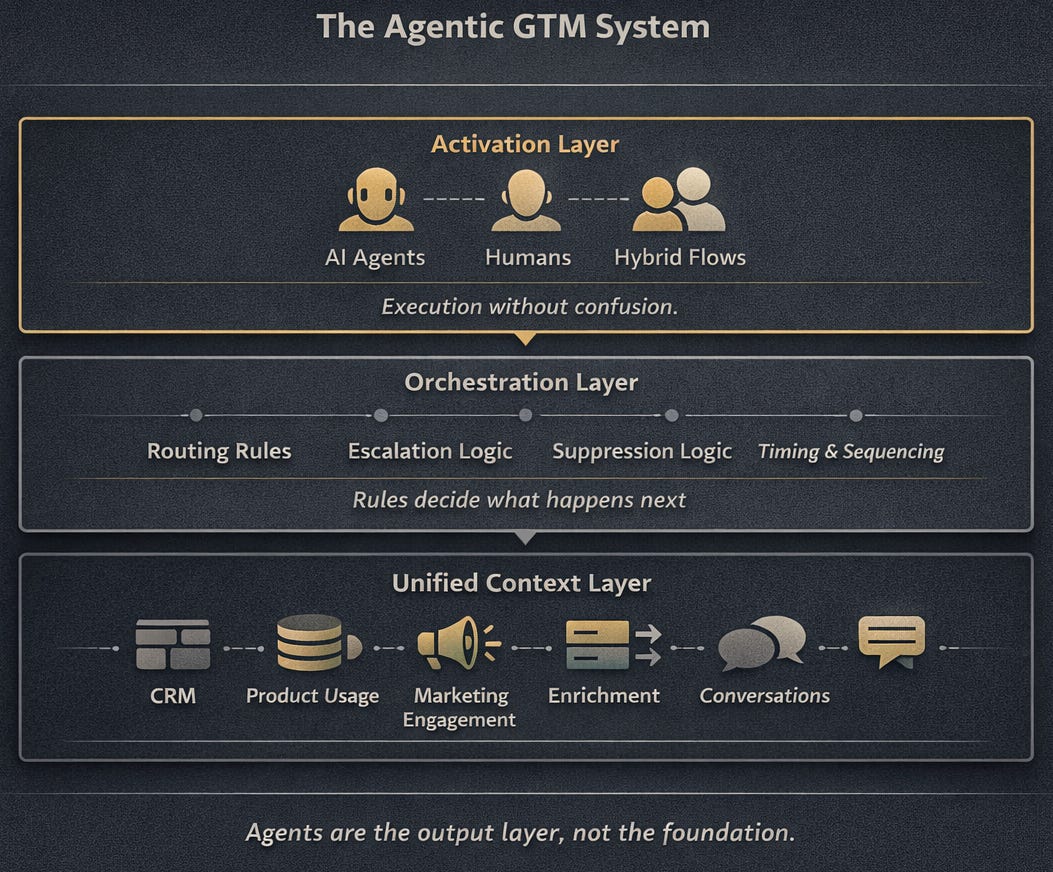
1. A Unified System of Context
Agentic GTM requires a single, continuously updated account-level view that every function operates from.
This context must unify product usage, CRM history, marketing engagement, firmographic attributes, and prior conversations into one shared representation of the buyer and the account. If marketing, sales, product, and customer success each operate from different versions of the truth, agents cannot reconcile that disagreement. They will simply pick one source of context and act on it.
A unified system of context ensures that every action taken by an agent reflects the same situational awareness a strong human operator would have.
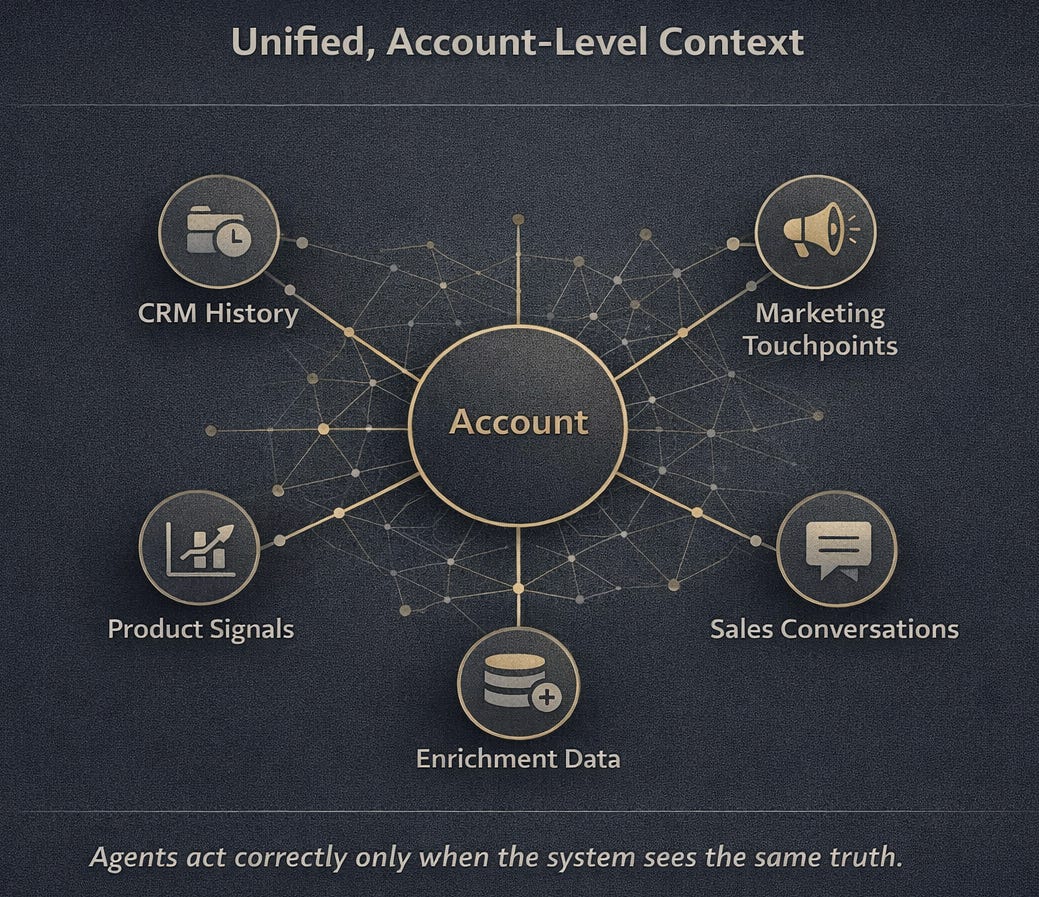
2. A System of Orchestration
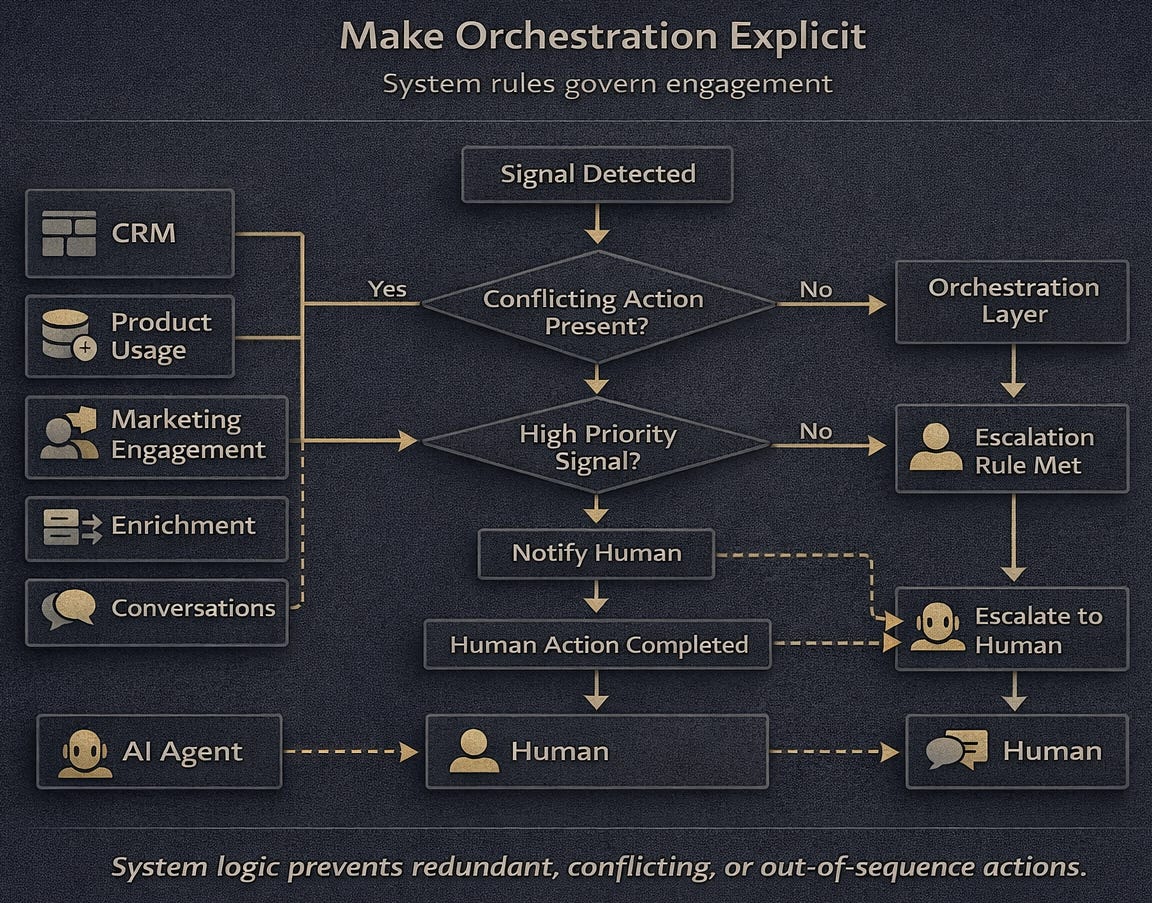
Context alone is not enough. Agents also require explicit rules that govern behavior across teams, channels, and moments in the buying journey.
Orchestration defines when a human should be involved, when an agent should act independently, which channels are appropriate, and which actions must be paused when another motion is active. Without orchestration, agentic GTM quickly devolves into friendly fire, where multiple teams engage the same account with conflicting messages that feel incoherent to the buyer.
Good orchestration does not slow GTM down. It removes friction by enforcing clarity.
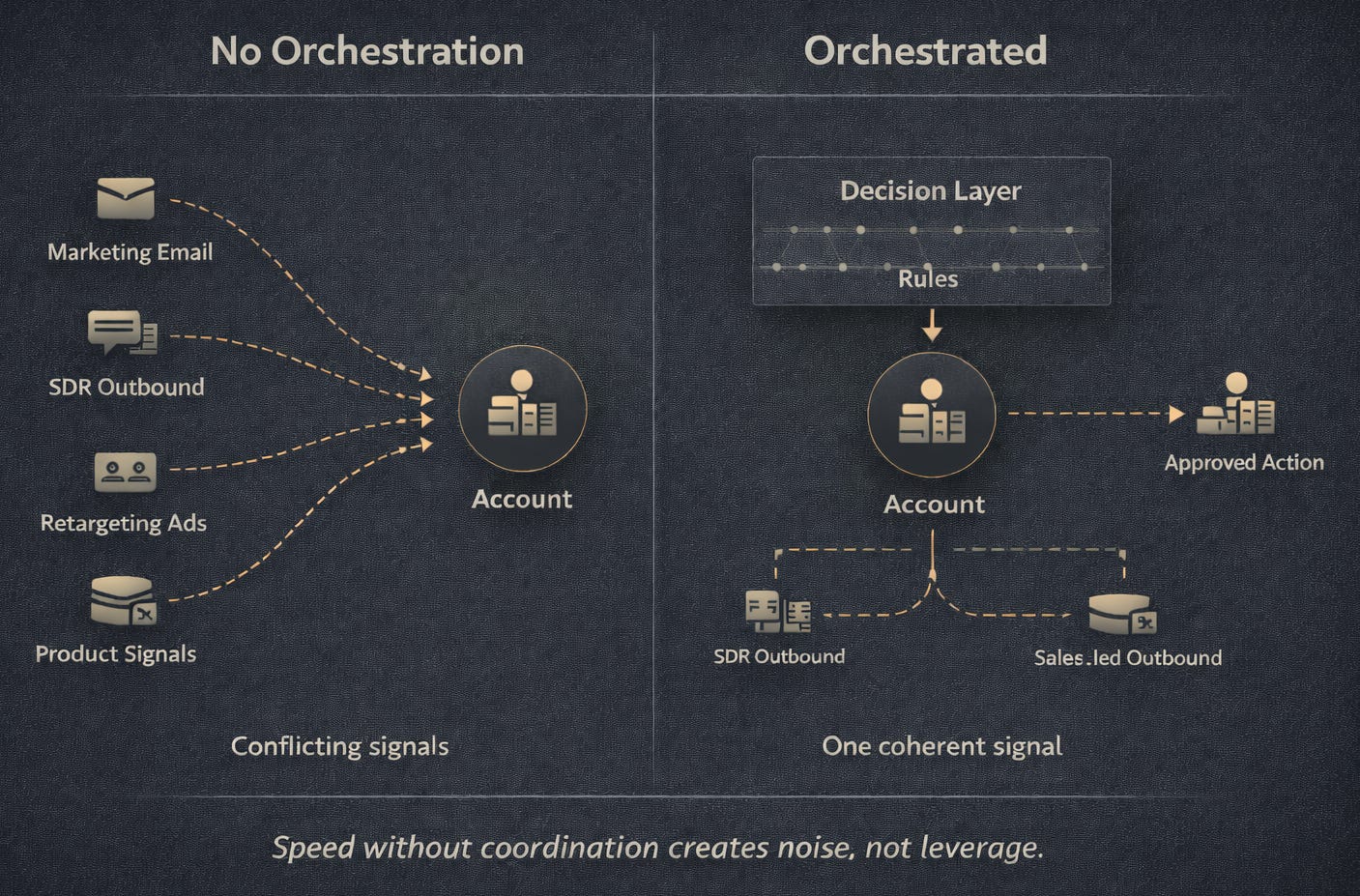
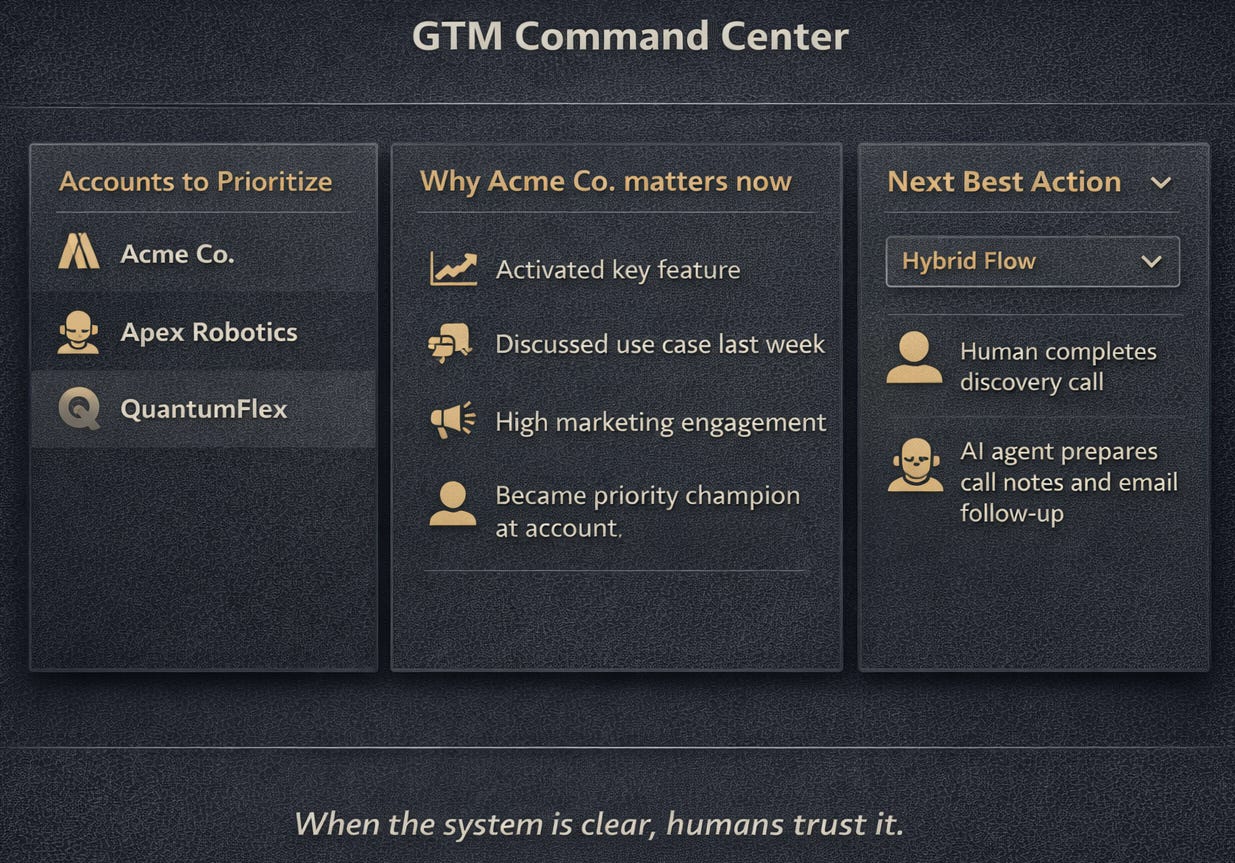
3. A Clear Activation and Control Surface
Even in agentic GTM, humans remain accountable for outcomes. That means the system must surface clear, prioritized actions rather than forcing operators to reconstruct context across tools.
A proper activation surface tells the operator which account matters now, why it matters, what action should be taken next, and whether that action is best handled by a human, an agent, or a hybrid flow. When reps are still acting as the integration layer, agents are not creating leverage. They are creating cognitive load.
What Agentic GTM Looks Like When the System Is Right
Consider two common B2B scenarios that reveal the difference between agentic GTM done poorly and done well.
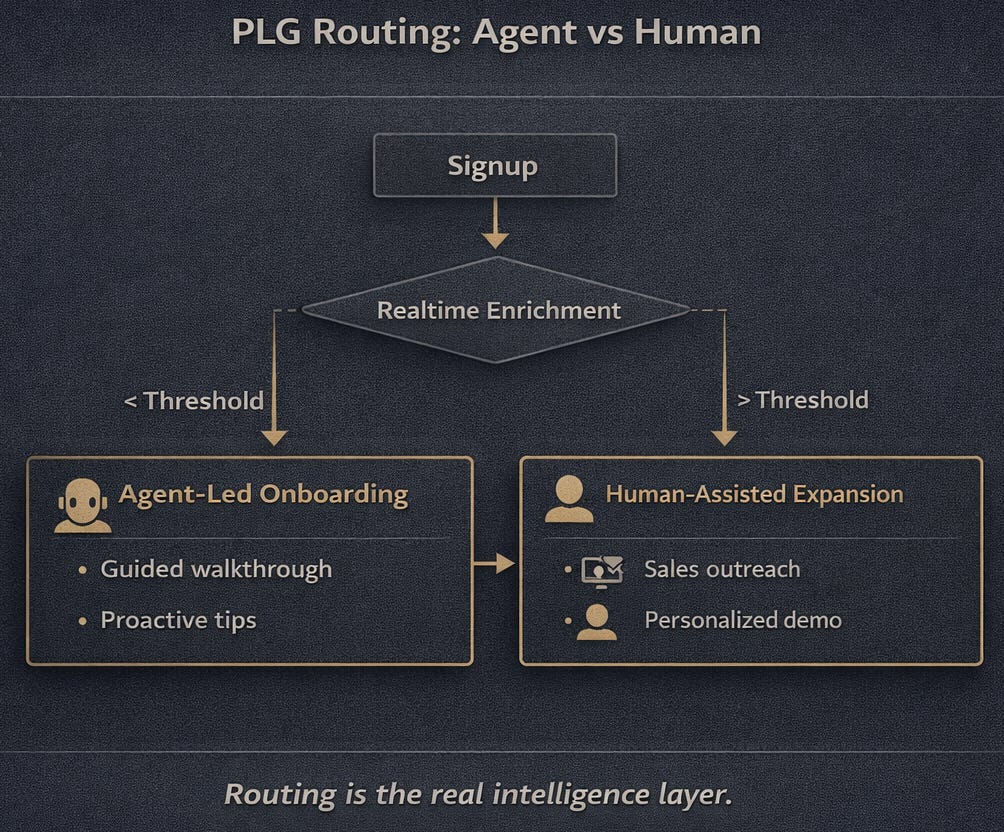
Product-Led Expansion in B2B SaaS
A new user signs up, activates a core feature quickly, and begins inviting teammates.
In a weak system, an agent sends generic onboarding, sales reaches out days later without context, and marketing continues a nurture sequence that ignores product usage. In a strong system, real-time enrichment occurs at signup, usage signals are evaluated immediately, and the system decides whether the account should remain agent-led or transition to human involvement.
The leverage does not come from smarter agents. It comes from smarter routing.
Mid-Market Sales-Led Motion
An account shows intent across content, product, and outbound.
In a weak system, multiple teams engage independently, messages conflict, and the buyer disengages. In a strong system, signals are aggregated at the account level, orchestration suppresses conflicting motions, and one coherent narrative is activated across channels. Agents support research and follow-up. Humans handle discovery and negotiation.
Alignment, not automation, creates velocity.
The Operator Insight
Agentic GTM is not a tooling upgrade.
It is a systems rebuild.
Teams that treat agents as shortcuts will blame AI when results disappoint. Teams that design context, orchestration, and activation deliberately will find that agents amplify clarity, speed, and relevance without adding headcount.
Pro Execution
How to Implement Agentic GTM in Production
Step 1: Build the Unified Context Layer First
Define the account as the primary unit of truth, not the lead.
Centralize CRM, product, marketing, and enrichment data at the account level. Resolve identities continuously rather than in batch jobs. Preserve historical interactions and outcomes so agents act with memory, not snapshots.
Consistency matters more than completeness.
Step 2: Make Orchestration Explicit
Before deploying agents, document the rules that govern engagement.
Define what actions should never happen simultaneously, when agents escalate to humans, when humans hand control back to agents, and which signals override all others. Treat orchestration as production logic, not campaign setup.
Step 3: Separate Intelligence From Execution
Avoid embedding core logic inside individual agents.
Centralize scoring, prioritization, and decision-making so agents consume decisions rather than invent them. This keeps behavior explainable, auditable, and consistent as the system evolves.
Step 4: Design the Human Control Surface Deliberately
Operators should not have to inspect multiple tools to understand what the system is doing.
The activation surface should show prioritized accounts, explain why actions are happening, allow humans to override agents when needed, and capture outcomes so the system improves over time. Trust is built when the system is legible.
Step 5: Measure System Health, Not Agent Activity
Avoid vanity metrics like messages sent or automations triggered.
Instead, track speed from signal to action, reduction in conflicting touches, conversion rates at key handoffs, and rep focus on high-impact accounts. When agentic GTM is working, noise decreases and leverage increases.
Final Word
Agentic GTM does not reward teams that move fastest.
It rewards teams that build foundations deliberately.
When context is unified, orchestration is explicit, and activation is intentional, agents stop feeling experimental and start feeling inevitable. The advantage compounds quietly, while everyone else wonders why their AI stack feels busy but ineffective.
For a deeper discussion on how pricing models outgrow revenue infrastructure in practice, see GTM 38: When Revenue Models Outgrow the Systems Running Them.